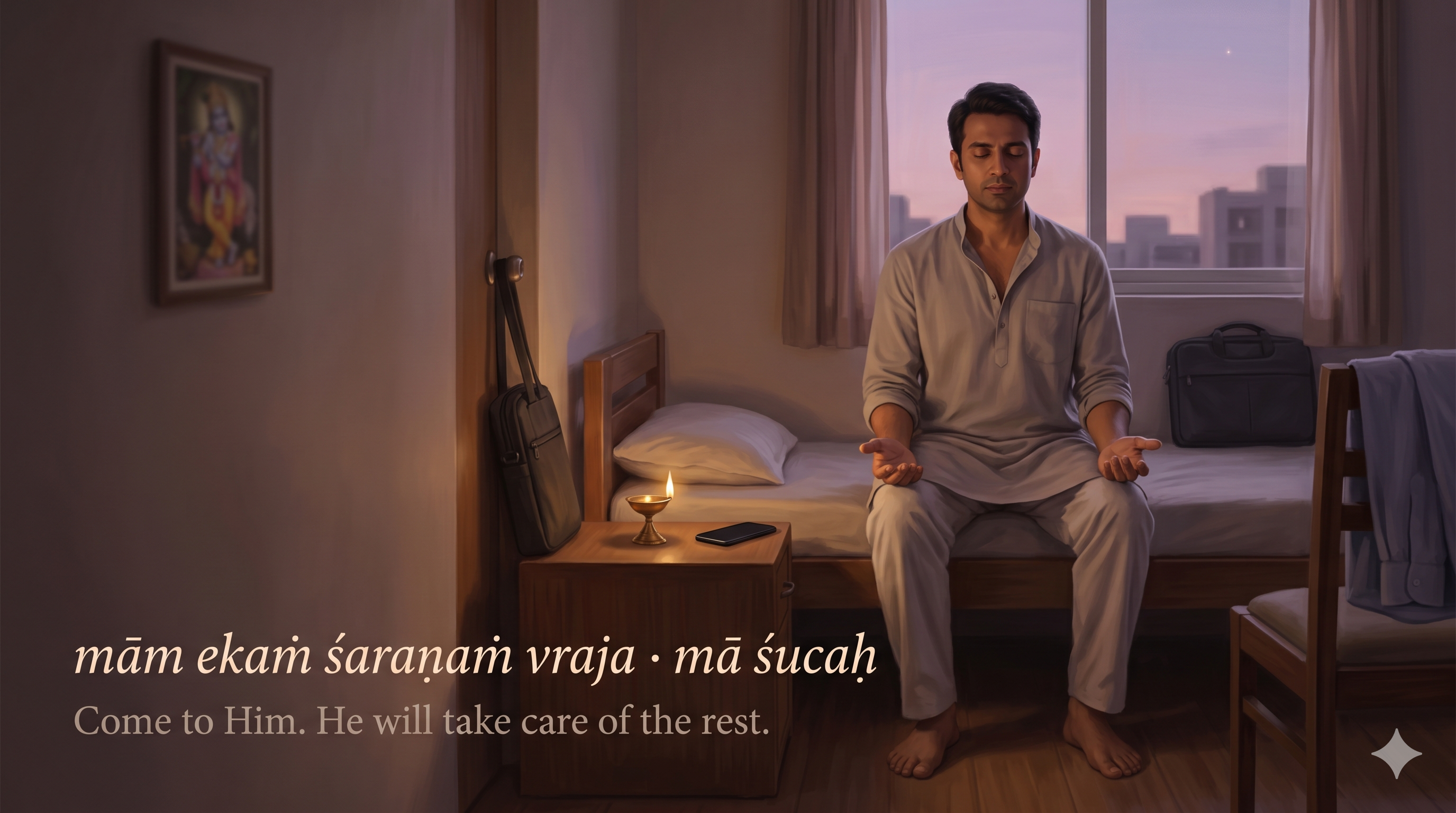
BG 1.46 — The Collapse
Verse anchor: sañjaya uvāca... visṛjya sa-śaraṁ cāpaṁ śoka-saṁvigna-mānasaḥ — Arjuna cast aside his bow and arrows, his mind overwhelmed with grief, and sank down on the seat of the chariot.

BG 2.7 — The Surrender to a Teacher
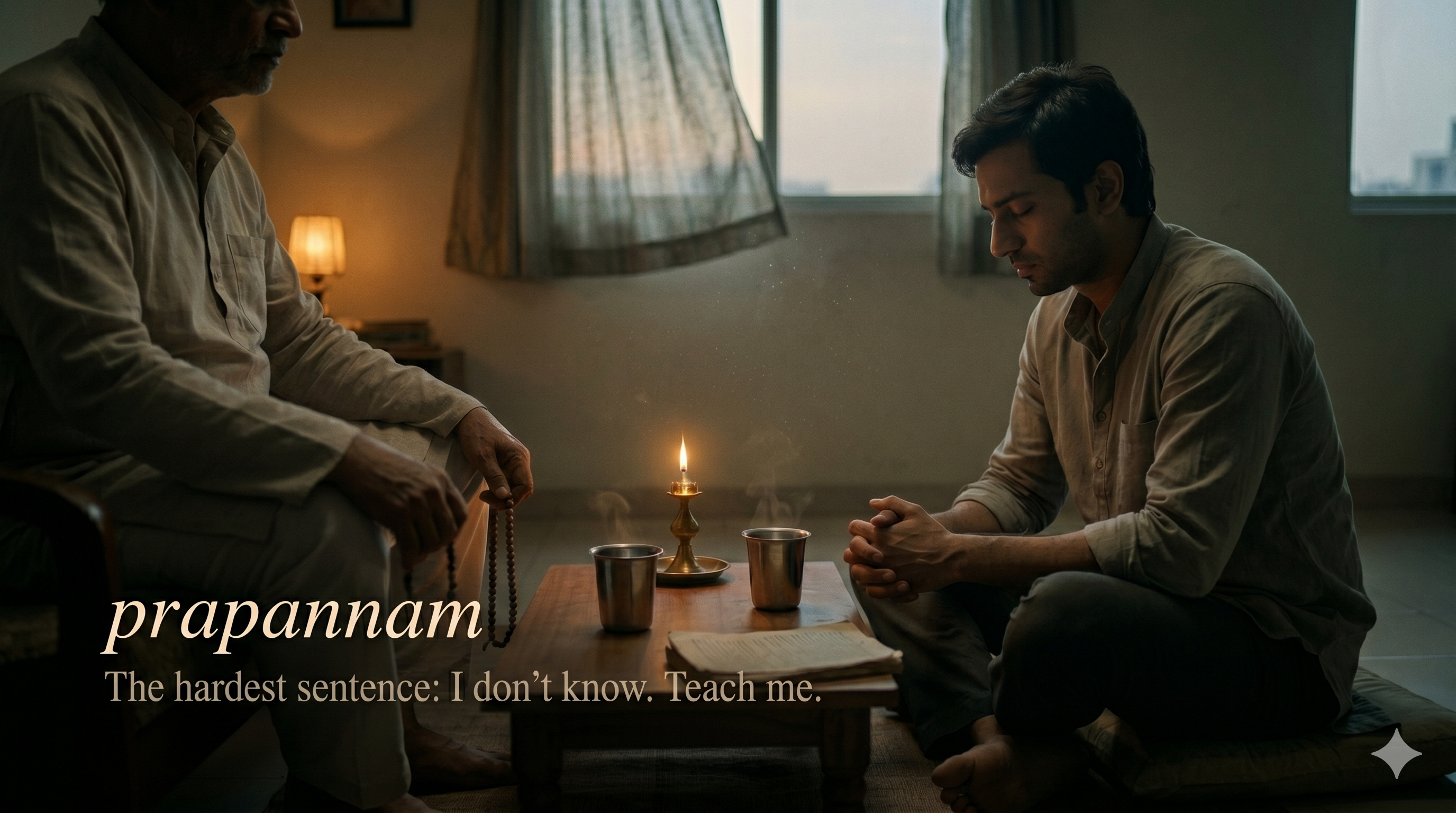
Verse anchor: kārpaṇya-doṣopahata-svabhāvaḥ pṛcchāmi tvāṁ dharma-sammūḍha-cetāḥ | yac chreyaḥ syān niścitaṁ brūhi tan me śiṣyas te 'haṁ śādhi māṁ tvāṁ prapannam — "My very being is struck by the weakness of miserly heart, my mind bewildered about duty, I am asking You: tell me decisively what is best. I am Your disciple. I am surrendered to You. Instruct me."
This is the single most important turn in the entire Gita. Arjuna stops arguing. He stops performing strength. He says śiṣyas te 'haṁ — I am Your student — and prapannam — I have taken shelter. The Bhagavad-gītā as a teaching only begins here. Without 2.7, there is no 2.11. Without śiṣya-bhāva, there is no jñāna.
The shift from 1.46: In Ch1, the man was alone, collapsed, emptied. In Ch2.7, something cracks open — he reaches out. The pride that said "I can figure this out" breaks. He admits he needs a teacher.
BG 3.9 — Work as Sacrifice
Verse anchor: yajñārthāt karmaṇo 'nyatra loko 'yaṁ karma-bandhanaḥ | tad-arthaṁ karma kaunteya mukta-saṅgaḥ samācara — "Work done as a sacrifice for Viṣṇu must be performed; otherwise, work binds one to this material world. Therefore, O son of Kuntī, perform your prescribed duties for His satisfaction, and in that way you will always remain free from bondage."
This is the operating principle of Karma Yoga. Ch2 ended with surrender — "teach me." Ch3 answers the obvious next question: "So what do I do tomorrow morning at 9 AM?" Krishna's answer is not renounce work. It is re-aim it. The same action — same desk, same code, same client call — becomes either bondage or liberation depending on whom it is for. Yajñārthāt = "for the sake of yajña." Mukta-saṅgaḥ = "free from attachment." Work itself is not the problem; the orientation of work is.
The shift from Ch2: In 2.7, he asked. In 3.9, Krishna gives him a spec — a framework for action. The student has been admitted; now the curriculum begins.

BG 4.9 — The Knowledge That Ends the Cycle
Verse anchor: janma karma ca me divyam evaṁ yo vetti tattvataḥ | tyaktvā dehaṁ punar janma naiti mām eti so 'rjuna — "One who knows the transcendental nature of My appearance and activities does not, upon leaving the body, take his birth again in this material world, but attains My eternal abode, O Arjuna." This is the verse that breaks the wheel. Ch3 gave the method — work as yajña. Ch4 names the destination — na eti punar janma, no more birth. And it names the key — tattvataḥ, knowing in truth, not in concept. Krishna has just spent eight verses (4.1–4.8) describing His descents, avatāra-tattva, the divya (transcendental) nature of His appearance and pastimes. 4.9 is the payoff: if you understand THIS — not philosophically but in truth — the cycle ends.
The critical word is tattvataḥ. Prabhupāda hammers this in the purport: it is not enough to know about Krishna's birth and activities. Many people study the Gita, debate the Mahābhārata, even write PhDs on Krishna — and remain in saṁsāra. Tattvataḥ means knowing in the way that transforms. Knowing such that it ends the disease of repeated birth and death. This is the difference between jñāna as information and jñāna as realization.
The shift from Ch3: Ch3 was about what to do tomorrow morning. Ch4 lifts the gaze. It says: and here is what all this is ultimately for. The horizon of the practice is named. The student who started with "teach me" in Ch2, and got the daily method in Ch3, now sees the finish line.

BG 5.10 — Untouched While Fully Engaged
Verse anchor: brahmaṇy ādhāya karmāṇi saṅgaṁ tyaktvā karoti yaḥ | lipyate na sa pāpena padma-patram ivāmbhasā — One who offers all his actions unto Brahman (the Supreme), abandoning attachment, is not touched by sin — as a lotus leaf is untouched by water.
This is the operating answer to a tension Krishna has been building since Ch3. How can one act fully in the world — do business, raise a family, hold a job, fight a battle — and not become entangled? The answer is two-part:
Brahmaṇy ādhāya karmāṇi — offering all actions to the Supreme Saṅgaṁ tyaktvā — abandoning attachment to the results
The simile padma-patram ivāmbhasā is what makes the verse unforgettable. The lotus leaf grows in the water, on the water, from the water — and yet water rolls off it, never wets it. The leaf's surface has a quality (a waxy microstructure, the lotus effect, now well-known in materials science) that repels what surrounds it. The yogi has that quality. He lives in the world but the world does not adhere.
Critical theological note: the verse does NOT say avoid water. It does NOT say get out of the pond. The lotus is in the pond — that is its whole point. Renunciation here is not physical withdrawal but non-adherence while fully immersed. This is precisely the distinction Prabhupāda emphasizes in his Ch5 purports: karma-sannyāsa (renouncing action) vs karma-yoga (renouncing attachment to action). Krishna teaches the latter as superior throughout this chapter.
The shift from Ch4: Ch4 was the night of realization — knowledge settling in stillness. Ch5 is the return to engagement — the realized person now back in the water, fully active, untouched. The arc is: collapse → reach → re-orient → realize → re-engage-untouched.

BG 6.47 — Become a Bhakta
Verse anchor: yoginām api sarveṣāṁ mad-gatenāntar-ātmanā | śraddhāvān bhajate yo māṁ sa me yuktatamo mataḥ — "And of all yogis, the one who always abides in Me with great faith, worshiping Me in transcendental loving service, is most intimately united with Me in yoga and is the highest of all. That is My opinion."
This verse is the capstone of the entire Karma-Jñāna-Yoga progression (Chapters 1–6). Krishna has just spent the whole chapter describing the aṣṭāṅga-yogī — the meditator in a solitary place, controlled breath, fixed posture, withdrawn senses, single-pointed mind. The audience (Arjuna, you, the reader) is by now intimidated. I can't do that. I have a job. I have a family. I have a Pune commute. This dhyāna-yoga is not for me.
Then 6.47 lands. Among ALL yogis — including that intimidating meditator — the one who comes to Me with bhakti, with śraddhā, with the heart turned inward to Me — that one is the topmost. The chapter doesn't end with "so become a mountain meditator." It ends with "so become a bhakta."

BG 7.7 — I am the Supreme
Verse anchor: mattaḥ parataraṁ nānyat kiñcid asti dhanañjaya | mayi sarvam idaṁ protaṁ sūtre maṇi-gaṇā iva — "O conqueror of wealth, there is no truth superior to Me. Everything rests upon Me, as pearls are strung on a thread."
This verse opens the Jñāna-Vijñāna Yoga movement. Ch7 begins (7.1) with Krishna saying śṛṇu — listen — and by 7.7 He has delivered the foundational ontological claim that everything else in Chapters 7–12 will rest upon: I am the supreme. Nothing is beyond Me. All that exists is strung on Me like pearls on a thread.
The simile is staggering. Sūtre maṇi-gaṇā iva — pearls on a thread. Each pearl is distinct, beautiful, separate. But what holds them in relationship, what makes them a necklace rather than a scattered pile, is the thread running invisibly through each one. The thread is not seen. Only the pearls are seen. And yet without the thread, there is no necklace — only chaos.
This is the metaphysical core of the entire Gita's worldview: the world is real, multiplicity is real, distinctions are real — but they are all held together by an unseen unifying reality. Not māyāvāda (the pearls are illusion). Not atheism (there is no thread). But acintya-bhedābheda avant la lettre — the pearls are real and the thread is real, and the relationship between them is the truth of existence.
Prabhupāda's purport here is firm: this verse refutes both impersonalism (which says only the thread is real, the pearls are illusion) and atheism (which says only the pearls are real, there is no thread). The Gita's position is that both are real, and the thread is Kṛṣṇa.
The shift from Ch6: Ch6 ended with bhajate māṁ — love Me. Ch7 opens with who is the Me you are loving? The first six chapters built the practitioner. The next six reveal the Beloved. 7.7 is the first declaration: I am the One on whom everything rests.

BG 8.5 — At the End Remember me ALONE
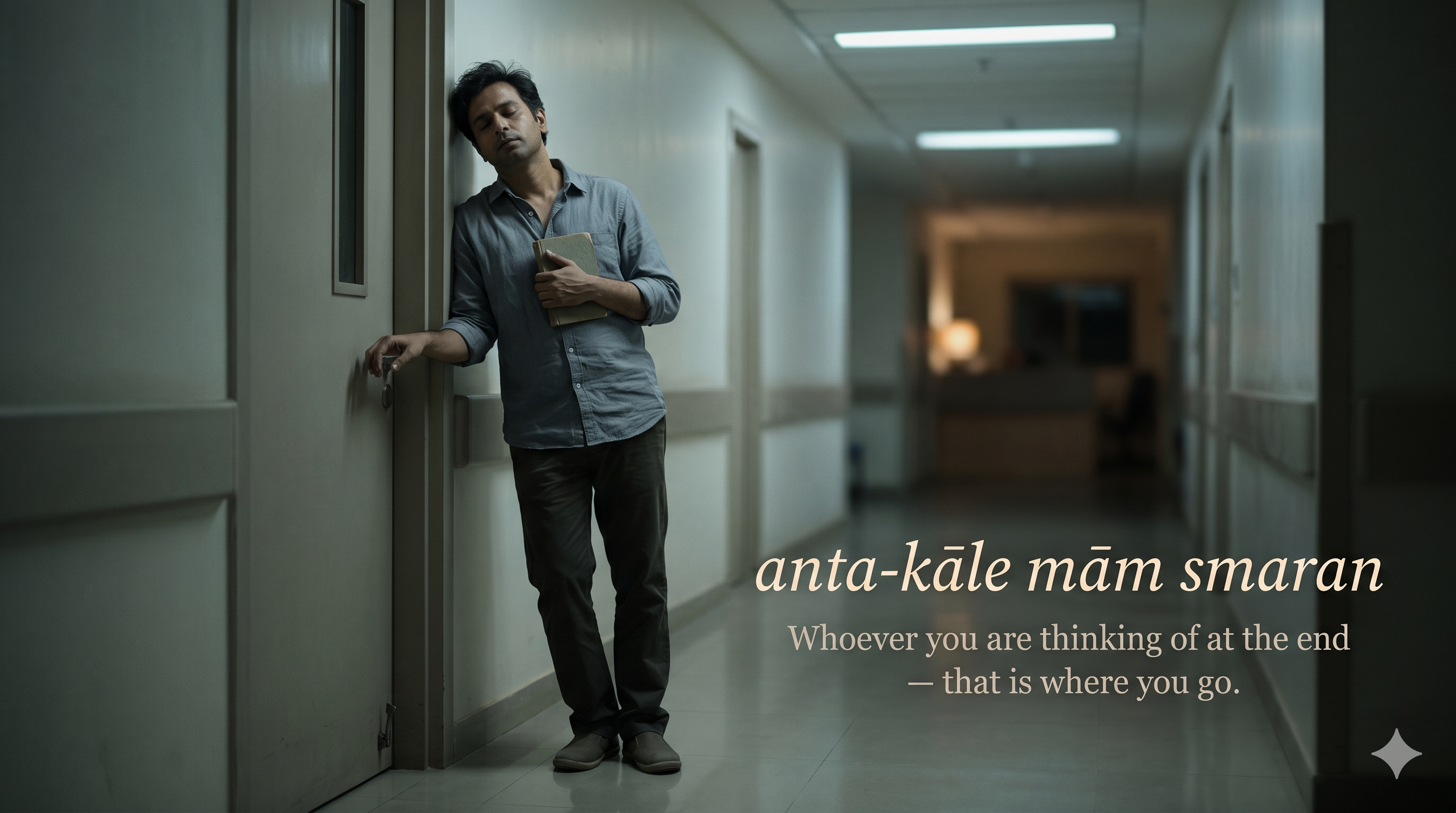
Verse anchor: anta-kāle ca mām eva smaran muktvā kalevaram | yaḥ prayāti sa mad-bhāvaṁ yāti nāsty atra saṁśayaḥ — "And whoever, at the end of his life, quits his body remembering Me alone, at once attains My nature. Of this there is no doubt."
This is the verse that names the single most important moment in a human life — anta-kāle, the time of death — and the single most important action at that moment — mām eva smaran, remembering Me alone. The verse is staggeringly direct. Nāsty atra saṁśayaḥ — there is no doubt about this. Krishna almost never closes a verse with that level of finality. It appears here because the stakes are total.
Two words do the load-bearing work:
Smaran — remembering. Not thinking about, not philosophizing, not praying to. Smaraṇa. The Sanskrit verbal root smṛ means to remember, to call to mind, to bring forward into consciousness what was already known. It is a recall, not a first-time encounter. This is critical: 8.5 presupposes that smaraṇa at the moment of death is possible only if there has been a lifetime of smaraṇa before it. You cannot suddenly remember someone you have ignored. The verse is not a deathbed loophole. It is the fruit of a life.
Anta-kāle — the end-time. Not just the literal moment of biological death, but the final state of consciousness in which the body is left.
Prabhupāda's purport hammers this — the consciousness at the moment of death determines the next state. Yaṁ yaṁ vāpi smaran bhāvaṁ tyajaty ante kalevaram (8.6) — whatever state of being one remembers when leaving the body, that state one attains. The mind at the final moment is the seed of the next life.The verse together carries a quiet thunder: your next existence is being authored right now, in how you are training your mind to remember. Every act of remembrance during life is a rehearsal for the one remembrance that matters. Smaraṇa is not a religious practice; it is the practice of dying well.
The shift from Ch7: Ch7 was the cosmic recognition — seeing the Beloved threading through everything. Ch8 turns the focus inward and forward in time — and how will you remember Him at the end? The bhakta who saw the Beloved in every light of the city (Ch7) now contemplates the moment when those lights will go out for him. This is not morbid. It is the most lucid possible question.
BG 9.34 — Just do these four things and come to Me
Verse anchor: man-manā bhava mad-bhakto mad-yājī māṁ namaskuru | mām evaiṣyasi yuktvaivam ātmānaṁ mat-parāyaṇaḥ — "Engage your mind always in thinking of Me, become My devotee, offer obeisances to Me and worship Me. Being completely absorbed in Me, surely you will come to Me."
This verse is a four-fold instruction that compresses the entire devotional path into a single śloka. Each of the four directives is a complete teaching by itself:
Man-manā — let your mind be in Me (the cognitive direction) Mad-bhakto — be My devotee (the relational identity) Mad-yājī — worship Me, offer to Me (the active practice) Māṁ namaskuru — bow down to Me (the bodily surrender)
These four are not optional alternatives. They are one practice with four limbs — mind, identity, action, body — all oriented toward the same Beloved. The verse names the complete reorientation of a human being around Kṛṣṇa.
The verse's significance compounds because Krishna repeats it almost verbatim in 18.65 — the closing of the entire Gita. Two of the eighteen chapters end with this exact instruction. Prabhupāda's purport calls 9.34 "the perfection of all yogic processes" and notes its repetition in 18.65 as Krishna's own emphasis: this is the essence. Of the eighteen chapters of the Gita, the formula given here is the one He felt important enough to give twice.
There is also a quiet theological precision in this verse — Krishna does not ask for belief. He does not ask for understanding. He asks for directionality — your mind, your identity, your offerings, your body, all turned the same way. Bhakti is not a belief system; it is a vector. The verse defines the vector.
The shift from Ch8: Ch8 was the clarifying moment — when the certainty of one's own death enters as a lived fact. The natural question that follows is: so what should I be doing with the rest of this life? 9.34 is the answer. Not a complicated answer. A four-word answer. Think of Me. Be Mine. Offer to Me. Bow to Me. The Beloved's instruction to the one who has just glimpsed the end.

BG 10.42
Verse anchor: atha vā bahunaitena kiṁ jñātena tavārjuna | viṣṭabhyāham idaṁ kṛtsnam ekāṁśena sthito jagat — "But what need is there, Arjuna, for all this detailed knowledge? With a single fragment of Myself I pervade and support this entire universe."
This verse is staggering in what it does. Krishna has just spent verses 10.21 through 10.41 describing His vibhūtis — I am Viṣṇu among the Ādityas, the sun among lights, Marīci among the Maruts, the moon among stars, the Sāma among Vedas, Indra among gods, mind among the senses, consciousness in living beings, Meru among mountains, the ocean among waters, the Ganges among rivers, the lion among beasts, Garuḍa among birds, the wind among purifiers, Rāma among warriors, the makara among fishes, time among reckoners, alphabet-letter A, compound dvandva, syllable Om, the silence of secrets, the wisdom of the wise...
The list is overwhelming by design. The reader feels the expanding scale of the Beloved's presence. Mountains, oceans, gods, demons, animals, languages, time itself — each named with "I am the topmost of that category." The reader, by verse 10.41, is appropriately staggered.
And then 10.42 lands. Atha vā — however. Bahunā etena kiṁ jñātena — what is the use of all this elaborate enumeration? Viṣṭabhya aham idaṁ kṛtsnam ekāṁśena sthito jagat — with a single fragment of Myself I support this entire cosmos.
The verse does three radical things at once:
One: It humbles the enumeration itself. All those thirty-five verses of opulence — Krishna says, gently, all of that was just to give you a sense. The actual reality is bigger than any list. The catalog was pedagogy, not totality.
Two: The word ekāṁśena — with one fragment, one portion, one part.
This is the single most theologically loaded word in the verse. Prabhupāda's purport emphasizes: even the entire material cosmos — kṛtsnam jagat, this whole universe — is sustained by one ekāṁśa of Kṛṣṇa. One part. The implication is that infinite parts remain. The visible universe, with all its galaxies and worlds, is a fragment. The Beloved is far more than the cosmos can hold.
This connects directly to the Brahma-saṁhitā concept of Mahā-Viṣṇu — that from one breath of Mahā-Viṣṇu, innumerable universes emerge, and from one aṁśa of Kṛṣṇa, Mahā-Viṣṇu Himself exists. The visible universe — staggering as it is — is not even close to the full reality of Kṛṣṇa.
Three: It is the most pastoral verse in Chapter 10. After overwhelming the student with grandeur, Krishna gently says, in effect: don't try to memorize all this. Just understand the principle. It is a teacher's act of mercy. The chapter does not end with "now learn all 35 of these by heart." It ends with "the point is, I am the source of all of it — and even all of it is only a fragment of Me."
The shift from Ch9: Ch9 was the daily formula — the small offering in the kitchen, the four-fold instruction compressed for a working life. Ch10.42 lifts the gaze in the opposite direction — and remember the One you are offering to is so vast that this entire cosmos is one fragment of Him. The chapter sequence has now done both: the intimacy (Ch9 kitchen offering) and the immensity (Ch10 cosmic ekāṁśa). Bhakti requires both.

BG 11.
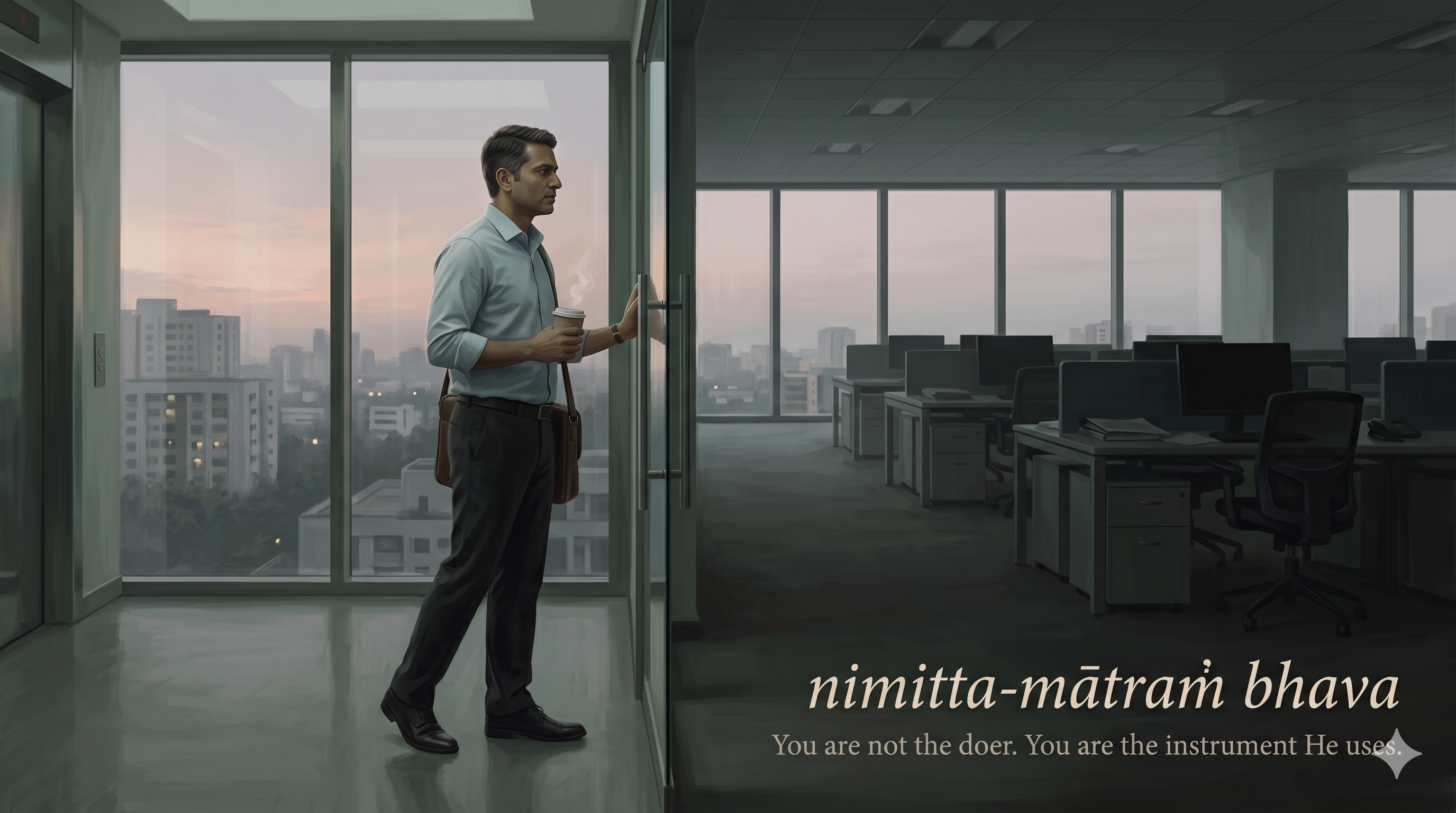
Verse anchor: tasmāt tvam uttiṣṭha yaśo labhasva jitvā śatrūn bhuṅkṣva rājyaṁ samṛddham | mayaivaite nihatāḥ pūrvam eva nimitta-mātraṁ bhava savyasācin — "Therefore get up. Prepare to fight and win glory. Conquer your enemies and enjoy a flourishing kingdom. They are already put to death by My arrangement, and you, O Savyasācin, can be but an instrument in the fight."
This is the single most important sentence Krishna says inside the universal form. Verses 11.15 through 11.32 have been the display — Arjuna seeing all warriors of both armies rushing into Kṛṣṇa's terrible mouths, being crushed between His teeth, the kāla (Time) consuming everything. By 11.32 Arjuna has just heard the chilling "Time I am, the great destroyer of worlds, here come forth to engage the destruction of these warriors."
Then 11.33 lands with a different register entirely. Krishna says, in effect: Now that you have seen this — get up. Fight. They are already dead. You are merely the instrument.
The verse contains four words that change everything for the practitioner:
Uttiṣṭha — rise up, stand up, get going. This is the same word the Upaniṣads use: uttiṣṭhata jāgrata prāpya varān nibodhata (Kaṭha Up. 1.3.14). It is the call to spiritual action. The universal form has been shown not so Arjuna can collapse in awe, but so he can rise and act.
Pūrvam eva nihatāḥ — they are already killed. By the cosmic order, by the inevitability of time, by Kṛṣṇa's arrangement. The outcome is not Arjuna's to determine. It has already been determined. Arjuna is not making the future happen; he is performing a future that already exists.
Nimitta-mātraṁ bhava — become only an instrument. This is the single most liberating phrase in the entire Gita for the urban professional reader. Nimitta = instrumental cause, the occasion through which a thing happens. Mātra = merely, only. Bhava = become, be. Become merely the instrument.
Prabhupāda's purport here is uncompromising: this is not fatalism, this is not abdication of responsibility, this is not "do nothing." It is the correct understanding of agency. The actor acts fully — Arjuna fights with all his skill, all his attention, all his courage — but he does not claim authorship of the outcome. He is an instrument fully employed and fully unattached. This is karma-yoga at its highest expression, now revealed not as a discipline but as a direct reality: you were always already an instrument. The universal form has just shown you the One who is actually acting.
Savyasācin — one who can shoot arrows with the left hand as well as the right. Krishna uses this epithet for Arjuna deliberately. He is naming Arjuna's capability — you are skilled, you are powerful, you are capable. The instrument is not a weak instrument. The instrument is the world's greatest archer. And yet — nimitta-mātraṁ bhava.The shift from Ch10: Ch10 was cosmic recognition — the man on the hilltop seeing the staggering scale of which the cosmos is a fragment. Ch11 is cosmic commission — and now that you have seen this scale, rise and act as its instrument. Ch10 lifted the gaze. Ch11 returns it to the work that must be done.
BG 12.20
Verse anchor: ye tu dharmyāmṛtam idaṁ yathoktaṁ paryupāsate | śraddadhānā mat-paramā bhaktās te 'tīva me priyāḥ — "Those who follow this imperishable path of devotional service and who completely engage themselves with faith, making Me the supreme goal, are very, very dear to Me."
This is one of the most tender verses Krishna speaks anywhere in the Gita. The full Bhakti-Yoga chapter has been a sustained meditation on the qualities of the dear devotee — verses 12.13 through 12.19 describe with extraordinary patience the characteristics of the bhakta priya (adveṣṭā sarva-bhūtānāṁ, santuṣṭaḥ satataṁ yogī, yo na hṛṣyati na dveṣṭi, samaḥ śatrau ca mitre ca, and so on). The chapter's emotional center is Krishna's repeated declaration: sa me priyaḥ — he is dear to Me. Priyo hi jñānino 'tyartham ahaṁ sa ca mama priyaḥ in 7.17 named the jñānī as dear. But Chapter 12 names the bhakta as dear — and 12.20 closes the chapter with a summative declaration that escalates: not just priyaḥ, but atīva me priyāḥ — very, very dear to Me.
The intensifier atīva — exceedingly, greatly, beyond measure — appears here for emphasis. Krishna has been calling these bhaktas priyaḥ throughout the chapter. In the closing verse, the intensifier lands: they are not merely dear, they are exceedingly dear to Me.
Three textual elements deserve attention:
Dharmyāmṛtam — the imperishable path of dharma, or the dharma which is itself amṛta (nectar, immortal). The compound is dense. Dharmya = pertaining to dharma, righteous, in line with eternal principle. Amṛta = imperishable, deathless, nectar. Together: the path that is both right action and the nectar of immortality. The qualities Krishna has just enumerated (12.13–12.19) are not moral codes; they are the very tasting of the deathless. The bhakta's quietude, the bhakta's evenness, the bhakta's non-enmity — these are themselves immortal nectar. The path is the destination.
Yathoktaṁ — as has been said, as I have just described. Krishna explicitly references the previous seven verses of qualities. He is not naming a new path here. He is closing the door on the chapter He has just opened. Those who follow this — exactly as I have just described it — are exceedingly dear to Me.
Mat-paramā — holding Me as the supreme. This is the verse's quiet theological filter. The qualities of 12.13–19 are not generic spiritual virtues. They are qualities of one who has made Kṛṣṇa the supreme goal. The same qualities in someone whose paramā is wealth, fame, or impersonal liberation are not what Krishna is describing. Mat-paramā is what makes the bhakta a bhakta — not the behavior alone, but the direction in which the behavior is offered.
Śraddadhānā — full of faith, established in faith. The verse echoes 9.34's śraddhāvān. The bhakta is not just practicing, but practicing with faith. The faith is what makes the practice fertile.
The shift from Ch11: Ch11 was the cosmic commission — the man at the office threshold, just received the instruction nimitta-mātraṁ bhava. Ch12 is the Beloved's response. Krishna has finished commissioning Arjuna (and the reader) and now, in 12.20, He turns and says: those who actually walk this path, the way I have just described — I love them. Exceedingly. The chapter sequence completes a movement: cosmic display (Ch11) → cosmic commission (Ch11) → and now the Beloved's tender declaration of His own affection for the one who has heard the commission and obeyed.
This is also the closing of the second six-chapter arc. The Gita is structured in three groups of six chapters (Karma 1–6, Bhakti 7–12, Jñāna 13–18). Your series mirrors this structure. Ch12 is the seal on the bhakti section. The verse is therefore performing a valedictory function — Krishna closing the most intimate of the three sections with the most tender statement of His affection for the practitioner.

BG 13.22 — The root cause of Birth in various Species
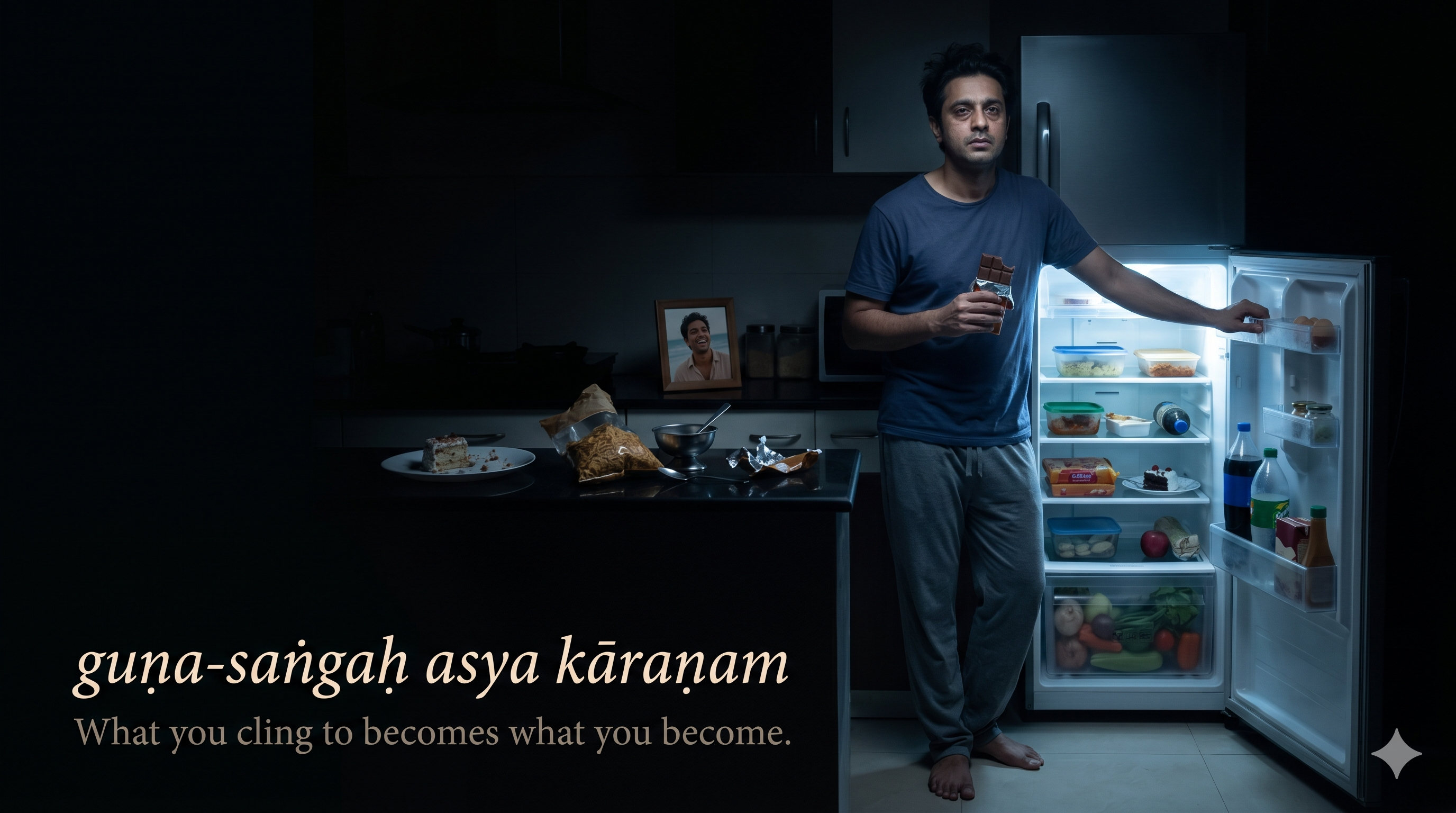
Verse anchor: puruṣaḥ prakṛti-stho hi bhuṅkte prakṛti-jān guṇān | kāraṇaṁ guṇa-saṅgo 'sya sad-asad-yoni-janmasu — "The living entity in material nature thus follows the ways of life, enjoying the three modes of nature. This is due to his association with that material nature. Thus he meets with good and evil among various species."
The verse contains the causal chain that produces saṁsāra:
Puruṣaḥ prakṛti-sthaḥ — the puruṣa situated in prakṛti. The living entity (jīva), originally a spiritual being, finds himself situated in material nature. This is the primordial misplacement. Prakṛti-stha = abiding in, dwelling within, taking shelter in prakṛti. The jīva is not prakṛti, but he is in prakṛti, like a man who has wandered into a forest and is now subject to its weather.
Bhuṅkte prakṛti-jān guṇān — enjoys the modes born of prakṛti. The jīva, situated in material nature, begins to enjoy the three guṇas — sattva, rajas, tamas. The word bhuṅkte (enjoys) is critical. The jīva does not neutrally experience the modes; he enjoys them — he develops a taste for them. Sattva produces a particular kind of pleasure, rajas another, tamas another. The jīva, finding himself in prakṛti's domain, begins to consume what prakṛti offers.
Kāraṇaṁ guṇa-saṅgo 'sya — the cause is his association with the modes. Saṅga is the verse's load-bearing word. Saṅga = attachment, association, contact, clinging. The jīva's saṅga with the guṇas — his clinging to them — is the kāraṇa (cause) of what follows next. Not the modes themselves. The modes are simply features of prakṛti. The problem is the jīva's attachment to them — his enjoyment of them — his identification with them. The Sanskrit is precise: guṇa-saṅgaḥ asya kāraṇam — attachment to the modes is THE cause.
Sad-asad-yoni-janmasu — in births in good and bad wombs. This is what guṇa-saṅga causes: repeated births in various species, some elevated (sat-yoni — human, demigod), some degraded (asat-yoni — animal, hellish). The jīva's particular saṅga — which mode he is most attached to — determines which kind of body he receives next. Sattva-saṅga elevates; rajo-saṅga keeps in human births of mixed quality; tamo-saṅga degrades. The karma mechanism of transmigration is guṇa-saṅga-mechanism. The verse delivers, in a single śloka, the entire diagnosis of saṁsāra:
1- The jīva is in material nature (prakṛti-stha). 2- He enjoys the modes (bhuṅkte guṇān). 3- His attachment to the modes (guṇa-saṅga) is the cause. 4- The result is repeated birth in various wombs, good and bad.
This is Prabhupāda's emphasis throughout his purport on this verse: attachment to the modes is the root of transmigration. Not action. Not desire in general. Specifically guṇa-saṅga — clinging to the qualities of material nature. And the solution, given in subsequent verses (13.23 onward), is precisely the cultivation of detachment from the modes through jñāna (the knowledge of the field and the knower) and ultimately bhakti (which 14.26 will name as the only effective method for transcending the modes).
13.22 is uncomfortably accurate. We live in a culture where guṇa-saṅga is normalized as personality. People identify with their attachments: "I am a foodie." "I am a workaholic." "I am someone who needs my coffee." "I am driven by ambition." "I am someone who loves comfort." Each of these is a guṇa-saṅga statement disguised as identity. The verse names what is actually happening: these are not who you are. These are what you have associated with. And that association is the cause of your repeated births in various conditions of suffering and pleasure.
The shift from Ch12: Ch12 was the closing of bhakti — the warmest possible image, the Beloved declaring His love. Ch13 turns to the cold diagnosis. Why does the jīva need the Beloved? Why does the bhakta's quiet park-bench moment matter? Because without it, this is what we are doing — wandering through prakṛti, attached to the modes, getting reborn in good and bad wombs, life after life. Ch13's verse is the background against which Ch12's tenderness becomes urgent. The bhakta is exceedingly dear to the Beloved because she has stopped clinging to the modes long enough to be claimed.
BG 14.26
This is the single most important verse in the entire Chapter 14, and arguably one of the three most important verses in the entire Gita for Vaiṣṇava soteriology. The chapter has spent twenty-five verses describing the three modes of material nature — sattva, rajas, tamas — their characteristics, their bondage-effects, their respective destinations after death (14.14–14.18: sattva to higher planets, rajas to human birth, tamas to lower species). The reader has been led through an exhaustive ontology of bondage. By 14.25 the question hangs in the air: how does anyone escape this? How does the jīva, who has been situated in prakṛti and clinging to the guṇas (the Ch13 diagnosis), ever transcend them?
14.26 is Krishna's answer. And the answer is not what the jñāna section has been preparing the reader to expect.
The verse contains three theological detonations:
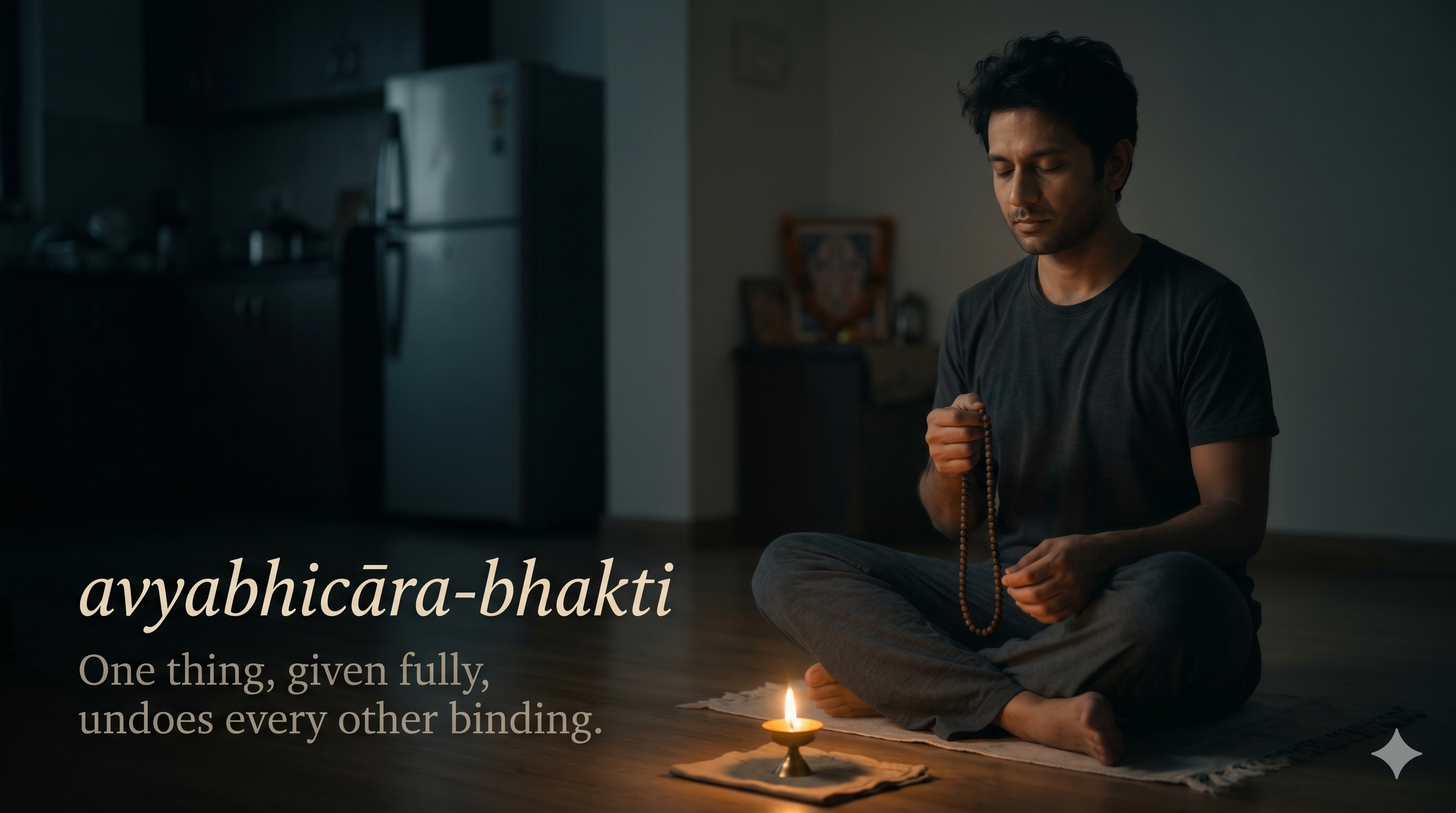
Avyabhicāreṇa bhakti-yogena — by unfailing, unwavering devotional service. The compound avyabhicāra means without deviation, without straying, exclusive. Not bhakti as one path among many. Not bhakti combined with other methods. Not bhakti when convenient. Avyabhicāra-bhakti — the exclusive, unwavering, undeviating devotional engagement. The qualifying word is critical because it distinguishes the means Krishna is naming from mixed bhakti (bhakti combined with karma, jñāna, yoga). What transcends the modes is pure unwavering bhakti alone.
Guṇān samatītya etān — transcends these modes, fully crosses over them. The verb sam-ati-i means to go completely beyond, to cross over entirely. Not to manage the modes. Not to balance them. Not to cultivate the higher mode (sattva) over the lower (tamas). The verse is uncompromising: all three modes are transcended. Including sattva. Including the highest mode — the mode of goodness, of dharmic action, of pious behavior, of religious observance. Sattva is also transcended. This is staggering because the previous twenty verses have been praising sattva relative to rajas and tamas. Now Krishna says: even sattva is to be transcended. The bhakta does not become a sattvic person; he becomes a transcendental person — guṇātīta.
Brahma-bhūyāya kalpate — becomes fit for Brahman-realization. The phrase brahma-bhūyāya kalpate is theologically loaded in a way that is easy to misread. Impersonalists read this as "becomes Brahman, merges with the impersonal absolute". Vaiṣṇava ācāryas read this very differently. Prabhupāda's purport here is firm and detailed: brahma-bhūta (the related state mentioned in 18.54) is the qualified preliminary stage in which the jīva has transcended material identification and is now eligible for pure devotional service in its mature form. It is not the terminus of bhakti; it is the threshold of bhakti's maturity. The brahma-bhūta stage is where parā bhakti (highest devotion) begins (18.54: brahma-bhūtaḥ prasannātmā... mad-bhaktiṁ labhate parām). The bhakta who transcends the modes through unwavering bhakti enters the brahma-bhūta state — and from there, attains the highest devotion.
The verse is therefore the single most precise statement in the Gita of how bhakti relates to the guṇa-bondage diagnosed in Ch13 and described in Ch14. The mechanism: unwavering bhakti directly transcends all three modes, including sattva itself, and brings the jīva to brahma-bhūta — the threshold from which mature devotional service unfolds.
There is also a quieter detonation in the verse's grammatical position. Krishna is in the middle of the jñāna-section of the Gita (Chapters 13–18). He has been speaking in the analytical register of kṣetra, kṣetrajña, the three modes, the field of action. Then, in 14.26, bhakti enters the jñāna section as the operative method. The verse is Krishna's first explicit declaration, in the final third of the Gita, that bhakti is the only effective means. He will repeat this at 18.55 (bhaktyā mām abhijānāti) and at 18.66 (mām ekaṁ śaraṇaṁ vraja). 14.26 is the first of the three culminating bhakti-declarations of the jñāna section. For Vaiṣṇava ācāryas — Rāmānuja, Madhva, Vallabha, the Gauḍīya line — 14.26 is one of the verses they hammer to refute the impersonalist claim that the Gita teaches jñāna as the highest path. Krishna Himself, in the middle of His most analytical chapter, says: the way out of the modes is bhakti, and specifically avyabhicāra-bhakti — unwavering, exclusive, undeviating devotional service. Not analysis. Not detachment. Not cultivation of sattva. Bhakti.
The shift from Ch13: Ch13 (in Prabhupāda's numbering) was the diagnosis — the jīva clinging to the modes, embodied in the man at the midnight fridge. Ch14 is the prescription — and the prescription is not the chapter's analytical framework about the three modes. The prescription is 14.26 itself — unwavering bhakti transcends them all. The two chapters together form the most important diagnosis-and-treatment pair in the entire Gita. Here is what binds you. Here is how you transcend it.
BG 15.7 — The Soul is Fragment of the Lord
Verse anchor: mamaivāṁśo jīva-loke jīva-bhūtaḥ sanātanaḥ | manaḥ-ṣaṣṭhānīndriyāṇi prakṛti-sthāni karṣati — "The living entities in this conditioned world are My eternal fragmental parts. Due to conditioned life, they are struggling very hard with the six senses, which include the mind."
This verse is one of the three or four most theologically detonating verses in the entire Gita — and arguably the single most important verse for Vaiṣṇava ontology of the jīva. Chapter 15, Puruṣottama Yoga, has been building toward a complete revelation of who Kṛṣṇa is, who the jīva is, and what the relationship between them is. By 15.7, Krishna delivers the verse that defines the jīva's eternal nature and identity. The verse contains the entire siddhāntic foundation against which both Māyāvāda and the various impersonalist drifts collapse.
The verse's five words do staggering work:
Mama eva aṁśaḥ — My own fragment, My own portion. The jīva is Kṛṣṇa's aṁśa. Not Kṛṣṇa's creation in the sense of something made from nothing. Not Kṛṣṇa's manifestation in the impersonalist sense (where the jīva would be temporary and ultimately unreal). The jīva is part of Kṛṣṇa. The word aṁśa — fragment, portion, part — is precise. Like a fragment of gold is still gold (in quality), but is not the whole gold mountain (in quantity), the jīva is qualitatively identical with Kṛṣṇa (consciousness, eternity, blissful nature) and quantitatively infinitesimal compared to Him.
This is the acintya-bhedābheda of Caitanya Mahāprabhu compressed into two words. Bheda — distinction (the jīva is an aṁśa, not the whole). Abheda — non-distinction (the aṁśa is of the same nature as the whole). Acintya — inconceivable (the relationship is logically irreducible). The Gauḍīya siddhānta you teach in your BPSS Parents Track Q&A lives in this verse. Mama eva aṁśaḥ is the verse you would cite to a Māyāvāda-leaning student to refute the claim that the jīva is identical with Brahman. The jīva is aṁśa — part. Not whole.
Jīva-loke — in this world of living beings, in this jīva-realm. The verse locates the aṁśa — in this conditioned world. The jīva exists here, in this realm of conditioned beings. This is critical: the verse is not making a cosmological claim about jīvas in Vaikuṇṭha. It is making an immediate claim about the jīvas you are right now. The reader is the aṁśa. The verse is not theoretical; it is first-person.
Jīva-bhūtaḥ — having become a jīva, existing as a jīva. The compound is suggestive. The aṁśa of Kṛṣṇa has become a jīva — has come to exist in the jīva condition. There is a prior state implied. The aṁśa was aṁśa before becoming jīva-bhūta. This is the verse's quiet contribution to the jīva-origin question: the aṁśa is eternal (sanātanaḥ, next word), but the jīva-bhūta state — the condition of being a struggling jīva in the material world — is a come-to-be state, an acquired condition. The aṁśa-nature is original. The jīva-bhūta condition is consequent.
The jīva did originate in association with Kṛṣṇa, and the fall is anādi (beginningless within material time) per Bhaktivinoda Ṭhākura. The verse supports this position. The aṁśa is sanātana — eternal, originating with Kṛṣṇa. The jīva-bhūta condition (struggling in matter) is the secondary state the aṁśa entered. The verse does not deny jīva-origin; it names the original status (sanātana aṁśa) and the consequent status (jīva-bhūta) as distinct.
Sanātanaḥ — eternal, primordial, originally constituted. The aṁśa is not a temporary product of māyā. The aṁśa is not a manifestation that will dissolve back into Brahman. The aṁśa is sanātana — has always been an aṁśa, will always be an aṁśa, was an aṁśa before entering the jīva-bhūta condition, will remain an aṁśa after liberation. Sanātanaḥ refutes the Māyāvāda claim that the jīva is temporary, a false individual identity that dissolves at liberation. The jīva's individual identity as Kṛṣṇa's aṁśa is eternal. Liberation does not dissolve the aṁśa; liberation restores the aṁśa to its proper relationship with the Whole.
Manaḥ-ṣaṣṭhānīndriyāṇi prakṛti-sthāni karṣati — struggles hard with the six senses (including the mind) situated in material nature. This is the current condition of the jīva-bhūta aṁśa. The eternal aṁśa, having entered the jīva-bhūta state, is now struggling — karṣati, dragging hard, pulling against — with the six senses (the five sense organs plus the mind as sixth) which are situated in prakṛti. The verse names the jīva's operational reality: identifies with a body, dragged around by mind and senses, struggling. Not blissful, not liberated, not one with the Absolute. Struggling. With six instruments that are in prakṛti, not in him.
The verse is the complete diagnostic of the jīva's condition: an eternal fragment of the Lord, ontologically situated in the conditioned world, dragged around by senses and mind that belong to matter. And yet — eternally a fragment of the Lord. The condition is real and painful. The original status is real and unchanging. Both are true. The bhakti journey (the entire previous fourteen chapters of your series) is the journey from living as if only the conditioned state were real to living as the eternal aṁśa relating to the Whole from whom one is a fragment.
For your audience, this verse is the foundational statement of who they are. The urban professional reader has been raised on competing identity claims:
- Scientific materialism: you are a biochemical accident, your consciousness is an emergent property of brain tissue, when you die you cease.
- Western individualism: you are a unique self-authored identity, you make yourself through your choices, your meaning is whatever you construct.
- Pop spirituality / Western yoga: you are pure consciousness, you are one with the universe, your individuality is illusion.
- Religious traditions interpreted reductively: you are a soul created by God who will go to heaven or hell.
Krishna's 15.7 cuts across all four. You are an eternal fragment of Mine, currently in the conditioned realm, struggling with material instruments — and this is your enduring identity. Neither accidental matter nor self-authored individual nor dissolvable into the Absolute nor separately created soul. Eternal fragmental part of Kṛṣṇa Himself. The verse offers the urban professional reader a coherent answer to the identity question that no modern framework provides.
The shift from Ch14: Ch14 (14.26) was the method by which the jīva transcends the modes — unwavering bhakti. Ch15 (15.7) is the who-is-doing-the-transcending — who is the jīva that performs avyabhicāra-bhakti? He is Kṛṣṇa's eternal fragment. The verse-pair completes the bhakti as ontology picture: not just bhakti as practice (Ch14), but bhakti as the natural relationship of the fragment to the whole (Ch15). The jīva engages in bhakti not because it is commanded but because it is the constitutional position of the aṁśa relating to its Source.

BG 16.24 — Scripture as the Authority for Action
Verse anchor: tasmāc chāstraṁ pramāṇaṁ te kāryākārya-vyavasthitau | jñātvā śāstra-vidhānoktaṁ karma kartum ihārhasi — "One should therefore understand what is duty and what is not duty by the regulations of the scriptures. Knowing such rules and regulations, one should act so that one may gradually be elevated."
The verse closes Chapter 16 with the positive prescription that responds to the chapter's long analysis of demonic nature. Krishna has just spent twenty-three verses describing the āsurī sampad — the demonic disposition — culminating in 16.23's negative diagnostic about throwing off śāstra and acting by whim. Now, in 16.24, He completes the teaching with the constructive answer: therefore — make scripture your authority.
The verse's four operating phrases carry distinct theological weight:
Tasmāt — therefore. The opening word grounds 16.24 in the entire chapter's argument. The verse is not a freestanding command; it is the conclusion drawn from sixteen chapters of teaching about the divine and demonic dispositions. The reader who has followed the chapter understands: given that whim-driven action produces neither perfection, nor happiness, nor supreme destination — therefore... The therefore is doing the work of concluding an argument that has been built carefully.
Śāstraṁ pramāṇaṁ te — let śāstra be your pramāṇa. This four-word phrase is the single most important statement in the verse, and possibly the most foundational epistemological claim in the entire Gita. The word pramāṇa in Sanskrit philosophy refers to the authoritative source of valid knowledge. The classical Indian philosophical traditions recognize six pramāṇas: pratyakṣa (direct perception), anumāna (inference), upamāna (comparison), arthāpatti (postulation), anupalabdhi (non-apprehension), and śabda (verbal testimony from authoritative source). The Vedic-Vaiṣṇava tradition holds śabda-pramāṇa — and specifically śāstra-śabda — as the highest pramāṇa for transcendental knowledge, because the other pramāṇas (perception, inference) cannot access transcendental subject matter.
Krishna's instruction here is precise. Not use your intelligence to figure out duty. Not follow your heart. Not do what feels right. Let śāstra be your pramāṇa — let scripture be your epistemic authority — for the question of what to do and what not to do. This is the foundational instruction that the rest of the dharma tradition rests on.
Kāryākārya-vyavasthitau — in establishing what is kārya (to be done) and what is akārya (not to be done). The compound is precise: kārya-akārya names the moral question, and vyavasthiti names the act of establishing, determining, settling. The verse names the domain in which śāstra-pramāṇa operates: in establishing duty. Not in every domain of knowledge. Not for all empirical questions. For the specific question of duty — what ought to be done, what ought not to be done — śāstra is the authority.
This is theologically careful. Krishna is not saying that śāstra is the authority for all knowledge. Empirical questions (how does a wheel work, how does a plant grow, what is the population of Hastināpura) are settled by other pramāṇas. Śāstra-pramāṇa applies specifically to the moral and spiritual domain — kārya-akārya. The Vedic tradition's understanding of śāstra as pramāṇa is narrower and more rigorous than either secular dismissals of scripture ("religion has nothing to teach") or fundamentalist appropriations of scripture ("the Bible/Vedas are the authority on everything"). Śāstra has its proper jurisdiction, and within that jurisdiction it is supreme.
Jñātvā śāstra-vidhānoktaṁ karma kartum ihārhasi — having known what scripture has instructed, you ought to perform action here. The verse closes with the full instruction: not merely consult scripture, but know what scripture instructs (jñātvā — having understood, having studied), and then perform action (karma kartum) here (iha — in this world, in this life). The verse insists on active engagement with scriptural instruction — understanding before acting. The reader who takes śāstra as pramāṇa must actually study scripture and understand its instructions; he cannot merely cite scripture without understanding it.
The verse's full sweep is therefore: given the chapter's analysis of demonic disposition, therefore — let scripture be your authority for determining duty; understand what scripture has instructed; and act accordingly in this world. The verse is the foundational prescription for living a dharmic life in the Vaiṣṇava tradition.
For your audience, 16.24 is doing quietly revolutionary work. The urban professional reader has been raised on a foundational epistemic assumption that he or she may never have examined: moral authority resides in the autonomous individual conscience. This assumption is the bedrock of modern Western liberalism — that no external authority can determine right and wrong for me, that I must decide based on my own reasoning, conscience, and experience. The reader has absorbed this assumption from school, from popular culture, from the dominant intellectual climate of the last three centuries. Most readers have never seen the assumption named, let alone challenged.
Krishna's 16.24 names the assumption and challenges it. Not your conscience. Not your reasoning. Not your experience. Śāstra is the pramāṇa for the question of what to do. For the reader, this is philosophically destabilizing in a productive way. The verse invites a reconsideration of where moral authority comes from — and offers a coherent alternative to the autonomous-individual framework.
The verse also performs a quiet relief for the over-burdened modern reader. The contemporary professional is exhausted by the burden of moral self-authorship. Every choice — career, relationship, lifestyle, ethics, identity — is presented as something they must construct from first principles. This is psychologically crushing. 16.24 offers an alternative: there is an authoritative tradition. It has thought about these questions for thousands of years. You can consult it. You do not have to invent everything yourself. For the right reader, this is liberating, not constraining.
The shift from Ch15: Ch15 (15.7) named the ontological identity of the jīva — Kṛṣṇa's eternal fragment. Ch16 (16.24) names the epistemic instruction for how that fragment should act in the world. The verse-pair completes a foundational sequence: who you are (Ch15) + how you should know what to do (Ch16). The eternal fragment of the Lord operates not by autonomous self-authority but by śāstra-pramāṇa — the eternal teachings of the Lord's tradition. The two verses together establish the complete foundation for dharmic life: eternal fragment + eternal scriptural authority.

BG 17.3 — You Are What You Have Faith In
Verse anchor: sattvānurūpā sarvasya śraddhā bhavati bhārata | śraddhāmayo 'yaṁ puruṣo yo yac-chraddhaḥ sa eva saḥ — "O son of Bharata, according to one's existence under the various modes of nature, one evolves a particular kind of faith. The living being is said to be of a particular faith according to the modes he has acquired."
The verse is one of the most philosophically generative in the entire Gita. It opens Chapter 17 (Śraddhā-Traya-Vibhāga Yoga) by establishing the foundational claim that the rest of the chapter unpacks: that faith is the determining substrate of human identity. Arjuna has just asked, in 17.1, about people who worship with faith but without scriptural regulation — what is their status? Krishna's answer begins with 17.2 (faith is of three kinds — sāttvika, rājasika, tāmasika), and lands its foundational claim in 17.3.
The verse contains four operating phrases, each doing distinct work:
Sattvānurūpā sarvasya śraddhā bhavati — everyone's śraddhā arises according to their sattva. The Sanskrit sattva here is ambiguous in a productive way. It can mean being, essential nature, mental constitution (the existing state of the person), or it can mean the mode of sattva specifically (one of the three guṇas). Prabhupāda's purport leans on both readings: a person's śraddhā corresponds to their existential state, which is itself shaped by the modes they have acquired. The point is that faith is not random. Faith arises from who the person already is — from their conditioning, their guṇas, their accumulated saṁskāras. This is the first detonation: śraddhā is not a free choice. It is the natural expression of one's existing inner constitution.
Bhārata — O descendant of Bharata. Krishna's vocative is deliberate. He is addressing Arjuna by his ancient lineage — Bhārata — and through Arjuna, every reader who stands in that lineage of dharmic inquiry. The verse is addressed to the dharmic seeker, the one who wants to understand the structure of his own being.
Śraddhāmayo 'yaṁ puruṣaḥ — this person is made of faith, this human being is constituted by faith. The compound śraddhāmaya — consisting of, made of, suffused with, having the nature of śraddhā — is the verse's ontological declaration. The human being is not primarily made of biology, not primarily made of psychology, not primarily made of social conditioning. The human being is primarily made of śraddhā. Faith is the substrate of personal identity. Everything else — thoughts, feelings, choices, behaviors — flows from this faith-substrate.
This is the verse's second detonation, and it is radically counter-modern. Modernity holds that the human being is made of reason (Enlightenment view), or biology (materialist view), or social construction (postmodern view), or self-authored choice (existentialist view). Krishna's view: the human being is made of faith. Whatever you have most deeply trusted — that is what you are made of. Faith is ontologically prior to reason, biology, social context, and choice. Those follow. Faith is the foundation.
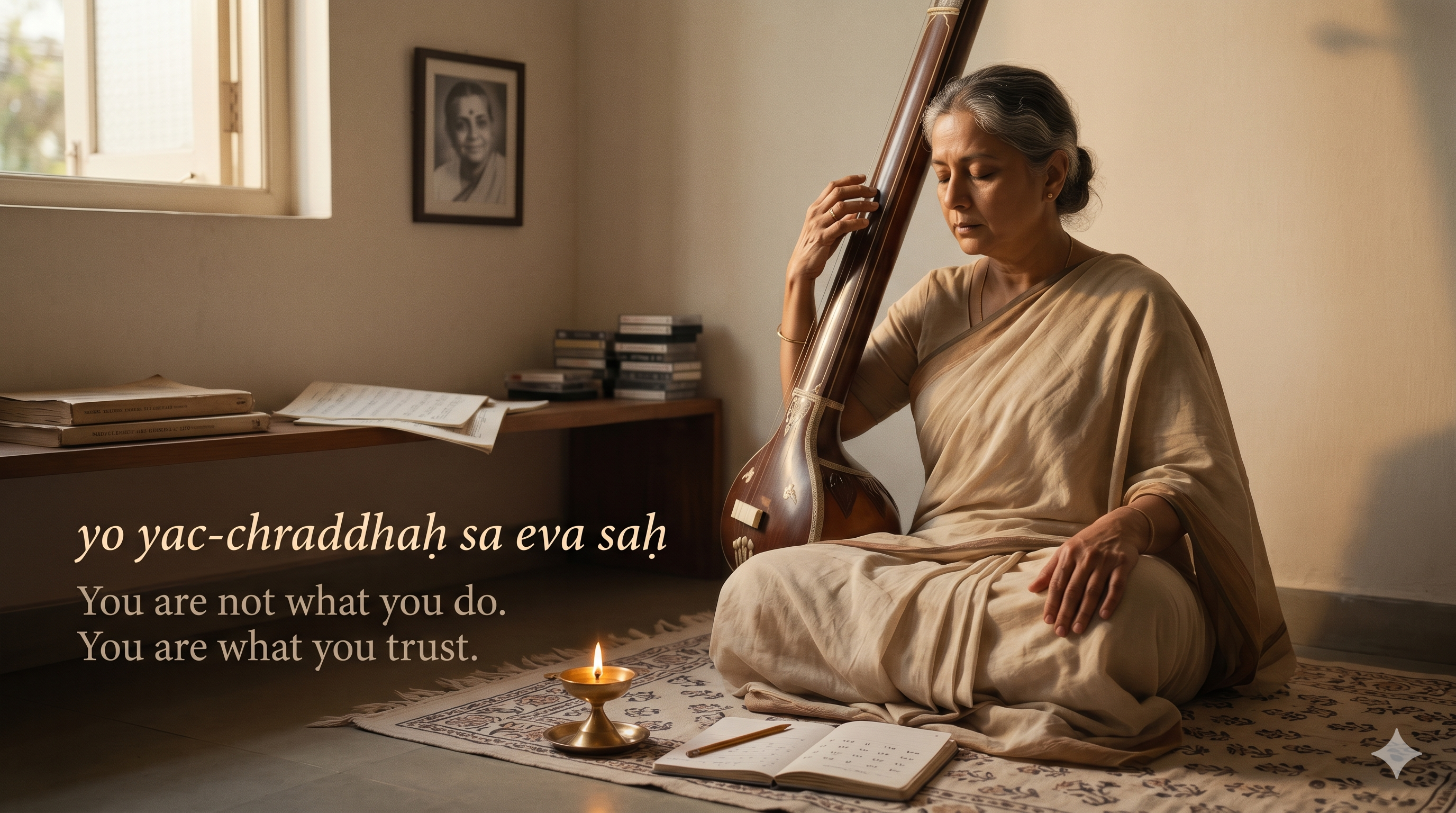
Yo yac-chraddhaḥ sa eva saḥ — whoever has whatever śraddhā, he is verily that. The final phrase is the verse's culminating identity claim, and it is one of the most quoted sentences in the entire Gita. The Sanskrit is grammatically dense and exactly translatable: yaḥ (whoever) yat-śraddhaḥ (is-having-faith-in-that) saḥ (he) eva (verily, indeed) saḥ (that). Whoever has faith in whatever, he indeed is that.
This is the verse's third detonation. Your identity is what you have faith in. Not correlated with. Not influenced by. Identical with. The person whose deepest faith rests in money is a money-person. The person whose deepest faith rests in their work is a work-person. The person whose deepest faith rests in Kṛṣṇa is a Kṛṣṇa-person — a bhakta — in their very constitution. Faith constitutes the self. Change what you have faith in, and you change who you are.
This claim is psychologically and spiritually devastating in the most useful way. It explains things the modern reader has felt but not named:
- Why do I feel hollow despite my achievements? Because what you have had faith in cannot sustain the kind of being you are made of.
- Why does Person A and Person B doing the same job lead such different lives? Because their śraddhās are different, and they are constituted by those śraddhās.
- Why can I not just decide to be a better person? Because being follows faith — change in being requires change in what you have faith in, not change in resolve.
- How does the bhakti path actually work? By gradually re-substrating the human being — by changing what the person has faith in, the person becomes a different person, constitutively. Bhakti is not a behavior layered on top of a self; bhakti is the re-constitution of the self around a new faith-substrate.
For urban professionals saturated with identity-construction language ("be your best self," "find your authentic identity," "discover who you really are") — 17.3 is the quiet correction that explains everything. You are not discovering who you are. You are not constructing who you are. You are what you have had faith in, over years, mostly unconsciously. The path forward is not self-discovery or self-construction but re-direction of faith.
The verse also offers practical diagnostic power. If a person wants to know who they actually are — beneath all the surface stories they tell themselves — they should ask: what do I actually have faith in? where does my trust most deeply rest? what do I structure my life around as if it were ultimately reliable? The answer to those questions reveals the person, more than any self-narrative or psychometric test.
The shift from Ch16: Ch16 (16.24) named śāstra-pramāṇam — scripture as the authority for the question of duty. Ch17 (17.3) names what shapes the person who is consulting scripture. The verse-pair is sequential: scripture is the authority (Ch16), and the person's śraddhā determines how they receive and engage scripture (Ch17). A person of sāttvika śraddhā engages scripture differently than a person of rājasika or tāmasika śraddhā. The same verse, read by two people with different śraddhās, lands differently — produces different actions, different transformations, different lives. Ch16 named the external authority. Ch17 names the inner condition that determines how the external authority is received. The two together complete the picture of how dharma actually operates in a human being.
BG 18.66 — The Final Surrender Verse
Anchor: sarva-dharmān parityajya mām ekaṁ śaraṇaṁ vraja | ahaṁ tvāṁ sarva-pāpebhyo mokṣayiṣyāmi mā śucaḥ — "Abandon all varieties of religion and just surrender unto Me. I shall deliver you from all sinful reactions. Do not fear."
This is the caramaśloka — the ultimate instruction, the final word of the Bhagavad-gītā. After seventeen chapters and 695 verses of teaching about karma, jñāna, bhakti, kṣetra, guṇas, the divine and demonic, faith, and śāstra, Krishna's concluding instruction is this single śloka. The tradition holds it as the most important verse in the entire Gita. The Vaiṣṇava ācāryas — Rāmānuja, Madhva, Vallabha, the Gauḍīya line — treat 18.66 as the verse that contains the entire Gita's essence. Rāmānuja wrote a separate brief commentary on 18.66 alone (the Gītārtha-saṅgraha's closing verses), considering it the verse on which the entire tradition rests.
The verse contains four operating phrases, each doing distinct theological work:
Sarva-dharmān parityajya — abandoning all dharmas, giving up all religious paths. This is the verse's first and most provocative claim. Krishna, who has spent seventeen chapters carefully describing various paths — karma-yoga, jñāna-yoga, dhyāna-yoga, varṇāśrama-dharma, śāstra-vidhi, threefold faith — now says: abandon all of it. Sarva — all. Dharmān — paths, duties, religious frameworks. Parityajya — having completely renounced, having entirely given up.
This phrase is the most theologically misread in the entire Gita. The impersonalist reading treats it as abandon all action and merge into the impersonal absolute. The materialist reading treats it as abandon religion altogether. Both are wrong. The Vaiṣṇava ācāryas read it precisely: sarva-dharmān parityajya means abandon all dharmas as your final shelter, as your ultimate refuge. Continue to perform dharma — Krishna has spent the entire Gita explaining how to do so — but do not take dharma itself as your ultimate destination. The shelter, the destination, the final refuge, must be Kṛṣṇa Himself, not the paths that lead toward Him.
Prabhupāda's purport here is firm: this is not a license to abandon prescribed duties. The Gita has just spent seventeen chapters teaching dharma. Sarva-dharmān parityajya names the internal renunciation of taking dharma as final. The bhakta continues to act — engages in karma, cultivates jñāna, practices yoga — but his shelter (śaraṇa) is Kṛṣṇa, not the practices. The practices are vehicles; Kṛṣṇa is the destination.
Mām ekaṁ śaraṇaṁ vraja — come, take shelter of Me alone. The phrase carries three load-bearing words:
Mām — Me. Personal pronoun, accusative. Me, Kṛṣṇa, the speaker of the Gita, the Supreme Person who has been progressively revealing Himself throughout the text. Not Brahman. Not the Absolute. Not some higher principle. Me — this specific Person, this Kṛṣṇa, the one who has been speaking to Arjuna and to the reader for seventeen chapters.
Ekam — alone, exclusively, only. The qualifier matters. Krishna does not say take shelter of Me and other gods, and dharma, and your own efforts. He says Me alone. The shelter is exclusive. Avyabhicāra-bhakti of Ch14 returns here in concentrated form — the bhakti that transcends the modes is exclusive bhakti, and the surrender that delivers from all sins is exclusive surrender.
Śaraṇaṁ vraja — come to shelter, go for refuge. The verb vraja is imperative — go! It is the same root as vraja (the holy land of Krishna's pastimes). The verb is active and imperative. Not meditate on Me, not think about taking shelter of Me, but come — take shelter — go to the refuge. The verse demands movement, action, a decisive turn. The surrender is not a passive state; it is an active step taken.
Ahaṁ tvāṁ sarva-pāpebhyo mokṣayiṣyāmi — I will deliver you from all sins, from all karmic consequences. The promise. The future tense (mokṣayiṣyāmi — I will liberate) is significant. Krishna is making a personal promise. The Sanskrit grammar names the direct subject (aham — I) and direct object (tvām — you) — I will liberate you. The promise is not mediated through dharma, through ritual, through cosmic process. I, personally, will personally liberate you.
This is the verse's most staggering theological claim. The entire previous tradition has held that karma operates by impersonal law — actions produce consequences, good produces good and bad produces bad, the wheel of karma turns according to its own logic. 18.66 says: I will deliver you from all sins, from all karmic consequences. The Supreme Person can override the karmic mechanism for the one who surrenders. This is grace as transactional override of karma — the central claim of all theistic Vedānta against Karma-Mīmāṁsā's impersonal law.
For us, this is the most consoling possible promise. We carry the weight of every past action — every harm done, every duty neglected, every wrong committed. The Karma-Mīmāṁsā framework says: you will reap what you have sown, life after life, until the karmic ledger is balanced. 18.66 says: surrender to Me, and I will personally clear the ledger. The shift is theologically enormous. Grace overrides karma. Surrender overrides accumulation. The Personal overrides the impersonal.
Mā śucaḥ — do not grieve, do not lament, do not be afraid. The verse's two-word closing is the gentlest possible reassurance. Mā — don't. Śucaḥ — grieve, lament. Do not grieve. The same phrase Krishna used to Arjuna at 2.11, at the beginning of His teaching, returns here at 18.66, at the very end. The Gita opens with grief (Arjuna's viṣāda, your Ch1 verse 1.46) and closes with the removal of grief (Krishna's mā śucaḥ). The arc is closed. The teaching that began in Arjuna's collapse ends in Krishna's reassurance: do not grieve. I will take care of you. Just come to Me.
The verse is therefore the entire Gita compressed. It contains:
- The renunciation dimension (sarva-dharmān parityajya)
- The bhakti dimension (mām ekaṁ śaraṇaṁ vraja)
- The grace dimension (ahaṁ tvāṁ ... mokṣayiṣyāmi)
- The consolation dimension (mā śucaḥ)
It is the teaching of teachings, the instruction beyond all instructions. The Gita's summum bonum in seventeen Sanskrit syllables.
The shift from Ch17: Ch17 (17.3) named what shapes who you become over time — śraddhā. Ch18 (18.66) names where śraddhā should ultimately rest — in Kṛṣṇa as exclusive shelter. The verse-pair completes the final foundational sequence: you are what you have faith in (Ch17) → have faith in Kṛṣṇa as exclusive shelter (Ch18). The series' closing arc — Ch15 (eternal fragment), Ch16 (śāstra as authority), Ch17 (śraddhā as identity-substrate), Ch18 (Kṛṣṇa as exclusive shelter) — forms a four-chapter complete foundation that culminates in the caramaśloka's final instruction.