
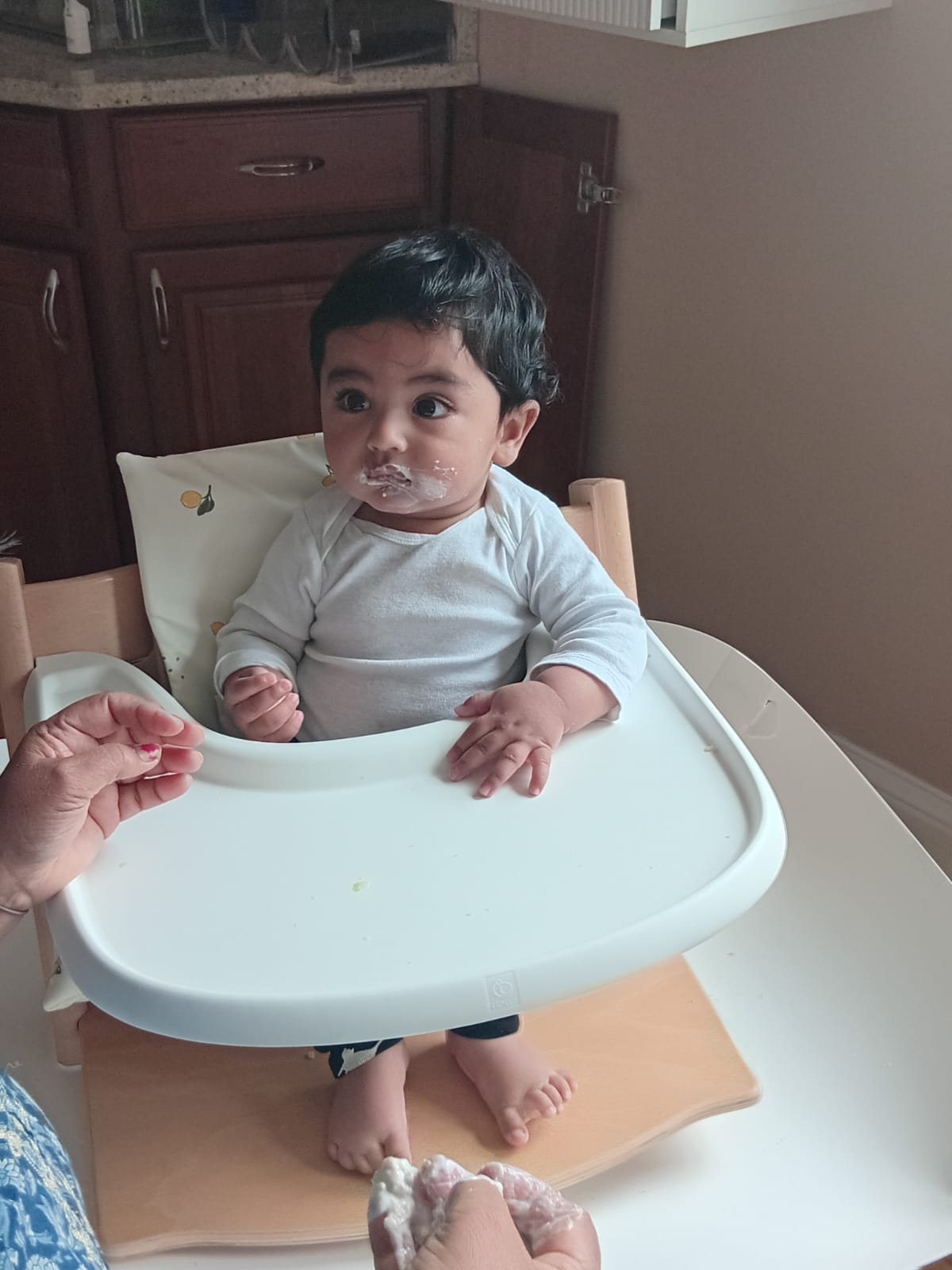
Reyansh, you are eight months old this month (May2026).
It is night. The fan is turning. Your mother has put you down on the bed and gone into the next room for two minutes, and you have done what you almost always do when you are left alone — you have become quiet. Not asleep. Quiet in the other way. Looking at something.
Tonight it is the moon.
The window is open and the curtain is moving slightly, and beyond the curtain there is a very ordinary half-moon — nothing dramatic, nothing full, just the moon as it usually is on a Tuesday in November. None of the adults in this house have looked at it. Your mother is making your bottle. Your father is on a phone call. I came in to check on you and found you completely absorbed, and I have been standing in the doorway for almost a minute now, watching you watch it.
I am writing this letter while it is still happening, Reyansh, because I do not want to lose it.
You are looking at the moon the way it deserves to be looked at.
You do not know that it is the moon. You do not know that it is far away, that it has no light of its own, that men have walked on it, that it pulls the sea. You do not know that it has a name in every language. You do not know that it has been written about more than almost any other object in the universe — that it appears in the songs of your great-grandmothers and in the prayers of strangers in countries you will never visit. You know none of this.
You are simply seeing it.
And in the seeing, you are doing something the rest of us have forgotten how to do. You are letting it be there. You are not naming it. You are not categorizing it. You are not, even for a moment, thinking oh, the moon — which is the small dismissal grown-ups perform a thousand times a day without noticing. You are not bored by it because it is familiar, because nothing is familiar to you yet. You are not impatient with it because there is somewhere else you need to be, because there is nowhere else you need to be. You are looking at the moon, and the moon is looking back, and between the two of you something is happening that the rest of us have not been part of for a very long time.
We grew out of it, Reyansh. That is the polite word for what happened. We grew out of looking at the moon.
I do not want you to grow out of it.
I should tell you a small secret about the moon. Most of what makes the moon beautiful is not the moon. It is the looking.
The moon has been doing exactly what it is doing tonight for four and a half billion years. It rose and set over dinosaurs. It rose and set over the men who built the first cities. It rose and set over the kitchens of every grandmother in your family — your mother's mother, your father's mother, the women before them whose names have been forgotten — and they too, at some point, looked up. Some of them only briefly. Some of them while they were tired. Some of them while they were heartbroken, while they were in love, while they were waiting for a child to be born. The moon was the same moon. What changed was the looking.
Tonight you are doing one of those lookings, Reyansh. You are joining a line.
You will not remember it. That is the cost of being eight months old. But it happened — I am writing it down so that somebody in this house will remember that on a Tuesday in November, when nobody else was paying attention, you noticed the moon, and the moon, in whatever way the moon notices anything, noticed you back.
There is a question I want to put gently into this letter, and then I will let it sit.
Why is it that we stop?
Why is it that the same moon which absorbs you completely tonight will, by the time you are twelve, be just the moon? It will not be smaller. It will not be less beautiful. The light will fall on your bedroom window in exactly the same way. What will have changed is that you will have learned, somewhere along the way, that the moon is not interesting. Nobody will have taught you this explicitly. You will have absorbed it from the room. You will have watched the grown-ups around you walk past windows for so many years that walking past windows will have become normal. The moon will become wallpaper.
This is what the world calls growing up, Reyansh.
I want you to know, on the authority of an old man who has done a great deal of both growing and ungrowing, that it is not growing up. It is going to sleep with your eyes open. It is a slow narrowing of what you allow yourself to notice. It is the price the world asks you to pay in order to be considered a serious person — and the price is too high, and almost everybody pays it, and almost everybody regrets it later without knowing what to call the regret.
I am writing these letters so that when you are forty, and you are walking past a window, and the moon is doing what the moon does, you will pause. Just for a moment. You will not know why. Something will have whispered.
That whisper is this letter.
There is a story, Reyansh, that I have loved since I was younger than you are now — though of course nobody could love anything younger than you are now, so let me say: since I was much younger than I am tonight.
Krishna, when He was a small boy in Vrindavan, once looked up at the moon and wanted it. Not the way you want a toy. The way you want what is beautiful. He was sitting in Yashoda's lap, and He pointed at the moon, and He cried for it — a small, soft, demanding cry, the way only a child whose mother will give him anything can cry. He wanted the moon, and He wanted it now.
Yashoda did not laugh at Him. She did not explain that the moon is far away, that the moon cannot be held, that the moon is not a thing children get. She held Him closer, and she did the thing that mothers in our family have done for thousands of years — she became inventive on His behalf. She held up a small mirror, or a bowl of water, or some say a brass plate, and she showed Him the moon's reflection in it. Here, she said, or something like it. Here is the moon. I have brought it to you.
And He accepted it.
I have thought about this story all my life. Not because of what Krishna did — He is the Lord, He can do whatever He likes — but because of what Yashoda did. She did not correct His wanting. She did not say the moon is too far. She did not say grow up. She honored the longing. She found a way to put the moon, in some form, into His hands.
This is what good love does, Reyansh. It honors the longing. Even when the longing is for impossible things — especially when the longing is for impossible things — it does not laugh, and it does not explain, and it does not say be reasonable. It looks for a mirror. It finds a way.
You will have many longings in your life. Some of them will be for things that are easy to give you. Some of them will be for things the world says you cannot have — and the world will be wrong about most of them, and right about a few of them, and you will not always know which. When you cannot tell, I want you to remember Yashoda and the brass plate. Not as a lesson. As a register. The register of a love that takes longing seriously.
The moon was reflected in the plate, Reyansh, and the child was satisfied. But here is the part of the story that almost nobody notices: what He was holding was still the moon. A reflection of the moon is not nothing. It is the moon, arrived in a form that a child's hands can receive. The whole universe is full of these reflections. The fan turning over your head is one. The breath in your chest is one. The light falling on your face right now from a half-moon above a Pune apartment is one. The moon you cannot reach is closer than you think.
You are eight months old, and you have figured this out already, and the rest of us are working very hard to forget it. That is the strangeness of being human. The youngest among us know the most, and we spend forty years getting back to where they started.
I am going to stop now, Reyansh, because your mother is coming back into the room and you are about to be picked up, and the moon will go back to being what the moon is when nobody is looking at it. Which is, of course, also wonderful, but in a quieter way that this letter is not equipped to describe.
Before I close, one small request.
When you are old enough to read this — twelve, sixteen, twenty, it does not matter — find a window. Find a moon. It does not have to be a special moon. A Tuesday moon is enough. A half-moon on a cloudy night is enough. Stand there for one full minute. Do not take a photograph. Do not think I should appreciate this. Do not think anything at all if you can help it.
Just look.
That is all. That is the whole instruction. Look at the moon the way you are looking at it tonight, in this room, while I write — without explanation, without category, without the small private dismissal that the rest of us cannot stop performing.
If you can do that, Reyansh, you will have learned more in one minute than most grown-ups learn in a lifetime. And the One who made the moon — who is, by the way, very interested in being noticed, and who arranges these moments more carefully than you would believe — will know that you have not entirely forgotten.
That is enough. That has always been enough.
Your grandfather is going now to make tea. The fan is still turning. You are about to be picked up. The moon will keep doing what the moon does, with or without our attention.
But tonight it had yours.
— Grandfather