
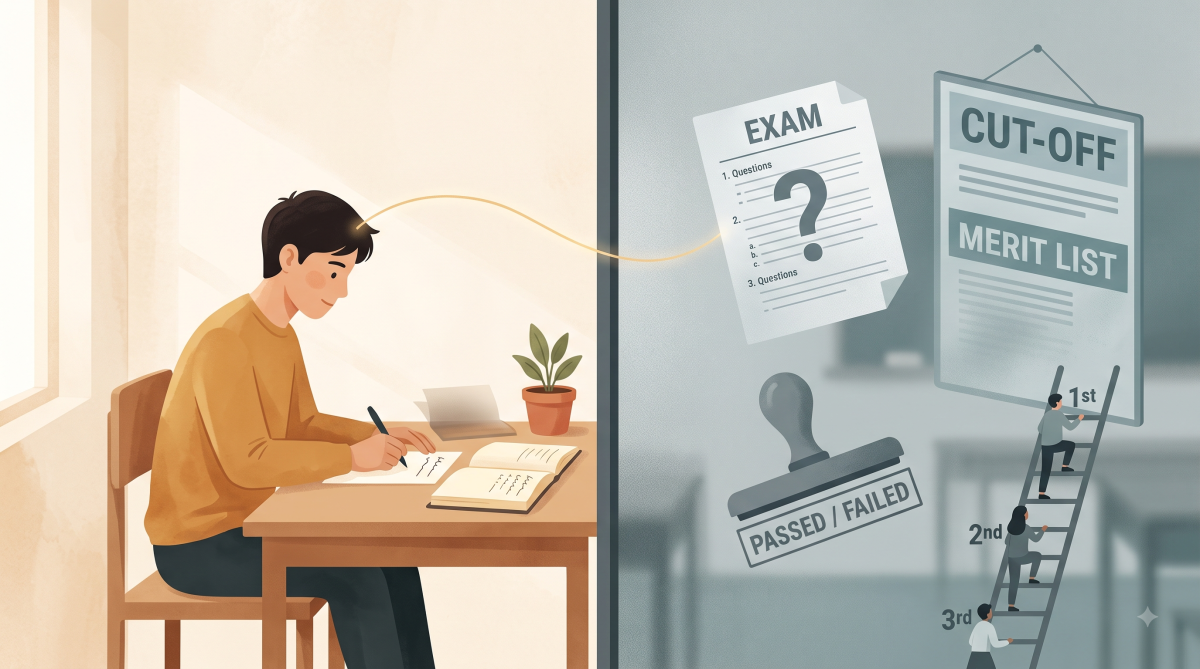
For students drowning in results season — the four-word teaching that tells you which half of your worry to drop.
The wrong side of the line
Think about the last exam that kept you up at night. Not the studying — the worrying. Replay the actual thoughts:
What if the paper is really hard this year? What if the cut-off is higher than last time? What if everyone else scored more than me? What mood will the examiner be in when he checks my answer sheet?
Now notice something about every single one of those thoughts.
Not one of them is about anything you control.
You cannot decide which questions they set. You cannot control how tough the paper is, where the cut-off lands, how the other students did, or whether the person grading your paper slept well the night before. And yet these — the things entirely outside your hands — are exactly what you lie awake obsessing over.
There is a bright line running down the middle of every exam. On one side is everything that's yours: how well you prepared, how carefully you read each question, how completely you emptied everything you know onto the page in those three hours. On the other side is everything that isn't yours: the paper, the cut-off, the examiner, the competition.
The entire anxiety of results season is one simple mistake — you keep pouring your energy across the line, onto the side you were never in charge of. 😮💨
The four words that fix it
Five thousand years ago, another young man froze under exactly this weight. Arjuna, the greatest archer of his age, stood on a battlefield and locked up — not because he lacked skill, but because he was terrified of the outcome. He was carrying the result before he had even acted.
Kṛṣṇa's answer to him is the most useful sentence a stressed student will ever read:
निमित्तमात्रं भव — nimitta-mātraṁ bhava — "Become merely the instrument."
In plain words: Do your part completely. Then let go of the result, because the result was never yours to hold.
Notice what Kṛṣṇa does not say. He does not say "relax, don't bother preparing, I'll handle it." Just before this, He tells Arjuna — get up and fight, with everything you have. He even calls him savya-sācin, "the expert archer," praising his skill in the same breath. 🏹
So this is not "leave it to God and don't study." That's the lazy misreading, and it fails every exam. This is the opposite: study with total seriousness — because the preparation is 100% yours — and then release the result, because the result is 100% not.
You write the paper. You don't grade it.
Play the ball, not the scoreboard
If you play any sport, you already understand this better than any philosophy could teach you.
A batsman controls his stance, his eye on the ball, his footwork, his shot. That's his whole job, and he does it with total focus. What he does not control: the pitch, the umpire's call, a freak gust of wind, or whether a brilliant fielder leaps and plucks a certain boundary out of the air.
And every coach in the world says the same thing to a nervous player: watch the ball, not the scoreboard.
Why? Because the batsman who is staring at the scoreboard — how many runs do I need, what's my average going to look like, what will people say — is the batsman who takes his eye off the ball and gets bowled. The runs are the result. They will come or they won't. But they were never the thing to watch. The ball is yours. The scoreboard is not.
Your studies are the ball. Your rank is the scoreboard.
The student watching the scoreboard — what rank will I get, what will the cut-off be, will I beat my friend — is taking her eye off the only thing that was ever in her hands: the ball in front of her, today. The chapter to revise. The problem to solve. The paper to write.
Play the ball, not the scoreboard. ⚡
But doesn't this mean I stop caring?
No — and this is the part that surprises people. Letting go of the result does not make you lazy. It makes you sharper.
Think about it. Where does most of your study-time energy actually leak away? Into fear about the outcome. The hours lost to spiralling — what if I fail, what will they think, what if it's not enough — are hours stolen from the one thing that would actually help: the ball in front of you. Anxiety about the scoreboard is the single biggest thief of the concentration you need to play the ball well.
When you drop the result, all that leaked energy comes flooding back to where it belongs — the chapter, the sum, the revision. You don't study less. You study better, because you're finally spending your whole mind on the only part that was ever yours.
The student who has truly handed over the result is not the one who stops trying. She's the one who can walk into the exam hall calm — not because she doesn't care, but because she has already done her job completely, and she knows the rest was never hers to carry. She writes the best paper she's capable of. And then she lets it go.
Before the next exam
Here is the whole teaching, small enough to keep in your pocket:
Your job is the preparation. Not the result.
Do your job fully — read every chapter, solve every problem, write every answer with everything you have.
Then hand the result to Kṛṣṇa, and sleep.
You are the batsman, not the scoreboard. You are the one who writes the paper — never the one who grades it.
Play the ball in front of you today. That was always the only thing that was yours.
Drawn from the Eleventh Chapter of the Bhagavad-gītā, "The Universal Form" (11.33). For the full depth of nimitta-mātram — "become the instrument" — sit with Śrīla Prabhupāda's Bhagavad-gītā As It Is.