

A mother stops speaking to her son because he said his wife comes first. Two cricket fans in Bengal and Odisha take their own lives after India loses a match. A tech worker in Silicon Valley cannot face his own children after a layoff. A woman delays having a family until her late thirties because pregnancy might "damage" her career trajectory. A teenager cancels plans because of a pimple.
These stories look nothing alike on the surface. Different people, different countries, different circumstances. But pull at the thread long enough and you find the same knot underneath every single one of them.
They all confused who they are with what they do.
And five thousand years ago, on a battlefield where the stakes were infinitely higher than any job or cricket match, Krishna addressed this exact confusion — in his very first substantial teaching to Arjuna.
What Krishna Said First — and Why It Matters
When Arjuna collapsed on his chariot, overwhelmed by grief and confusion, Krishna could have started anywhere. He could have opened with duty. He could have opened with dharma, with cosmic philosophy, with the nature of God. He had eighteen chapters worth of wisdom to deliver.
He started with identity.
dehino 'smin yathā dehe kaumāraṁ yauvanaṁ jarā tathā dehāntara-prāptir dhīras tatra na muhyati
"As the embodied soul continuously passes, in this body, from boyhood to youth to old age, the soul similarly passes into another body at death. A sober person is not bewildered by such a change." (Bhagavad Gita 2.13)
Read that again slowly. Krishna is not making a casual philosophical observation. He is performing surgery. He is cutting away the single most dangerous illusion a human being can carry — the belief that you are your body, your role, your position, your appearance, your job title, your relationship status.
You are the dehi. The one who lives in the body. Not the body itself.
This is not a poetic metaphor. This is the operating system of reality. And when you get this wrong, everything else in your life starts to malfunction.
Two Kinds of Identity
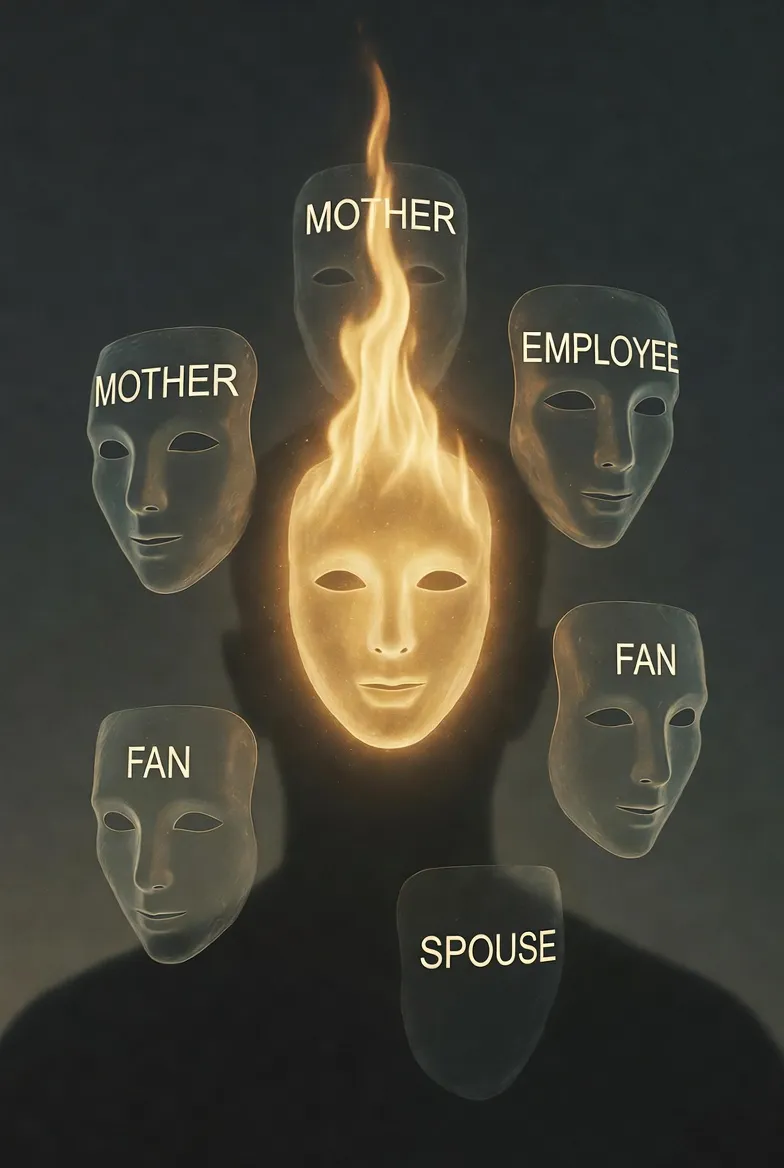
Think of it this way. You have a foundational identity and you have functional identities.
Your foundational identity is what you are at the root. According to Krishna, this is simple and non-negotiable — you are an eternal spirit soul, a part and parcel of the Supreme, whose natural position is to love and serve God. This identity does not depend on anything external. It does not require a salary, a spouse, a six-pack, a social media following, or a corner office. It cannot be taken from you by a layoff letter, a divorce paper, or a diagnosis. It is yours — permanently, unconditionally, across every birth and every death.
Your functional identities are the roles you play within this lifetime. Mother. Son. Husband. Employee. Indian. Student. Manager. Cricket fan. These are real. They matter. They come with genuine responsibilities and genuine joys. Nobody is saying you should not care about your job or your family or your country.
But here is where the trouble starts — when you take a functional identity and promote it to foundational status. When "I am a mother" stops being something you do and becomes everything you are. When "I work at Google" stops being your employment and becomes your entire sense of self. When "India is playing the final" stops being entertainment and becomes existential.
That promotion is the most dangerous career move you will ever make.
The Mother Who Could Not Let Go
Let's return to that dinner table.
A man tells a server — politely, calmly — that his wife comes first. A simple statement of marital reality. The kind of thing any healthy marriage requires.
And his mother shuts down. Silent treatment. Doors closed firmly. Cabinets banged. Dishes set down with just enough force to be a weapon.
What happened? Did the son insult her? Did he say he doesn't love her? Did he say she is unimportant?
No. He simply said she is second.
And that was unbearable. Because somewhere along the way, "I am his mother" had become her foundational identity. Her sense of self was built on being the most important woman in her son's life. When that position shifted — as it must, as it should, as every scripture and every tradition teaches that it should — she did not experience disappointment. She experienced an identity crisis.
This is not a character flaw unique to her. This is what happens to any human being when a functional identity gets mistaken for a foundational one. The son's marriage did not take anything real from her. She is still his mother. She is still loved. But the throne she had built for that identity — the centrality of it — that was challenged. And because she had nothing deeper to fall back on, the challenge felt like annihilation.
Now contrast this with another elderly couple. They live with their son and daughter-in-law. Same setup. Same potential for friction. But the atmosphere in that home is completely different. Why?
Because at their stage of life, this couple made a choice that most people never make. They consciously moved their primary identification away from "parent" and "in-law" and toward their spiritual identity. The mother, at her age, is pursuing Bhakti Shastri studies. Both husband and wife spend significant time in temple service. They are, in the truest sense, a Vanaprastha couple — still living in the family home but internally living a life of devotion and gentle renunciation.
The result? No cold wars. No competition with the daughter-in-law. No desperate clinging. They are genuinely blissful. Not because they stopped caring about their son, but because their son was never asked to carry the impossible weight of being their reason for existing.
They found their foundational identity. And it set everyone around them free.
When a Country Loses and You Lose Yourself
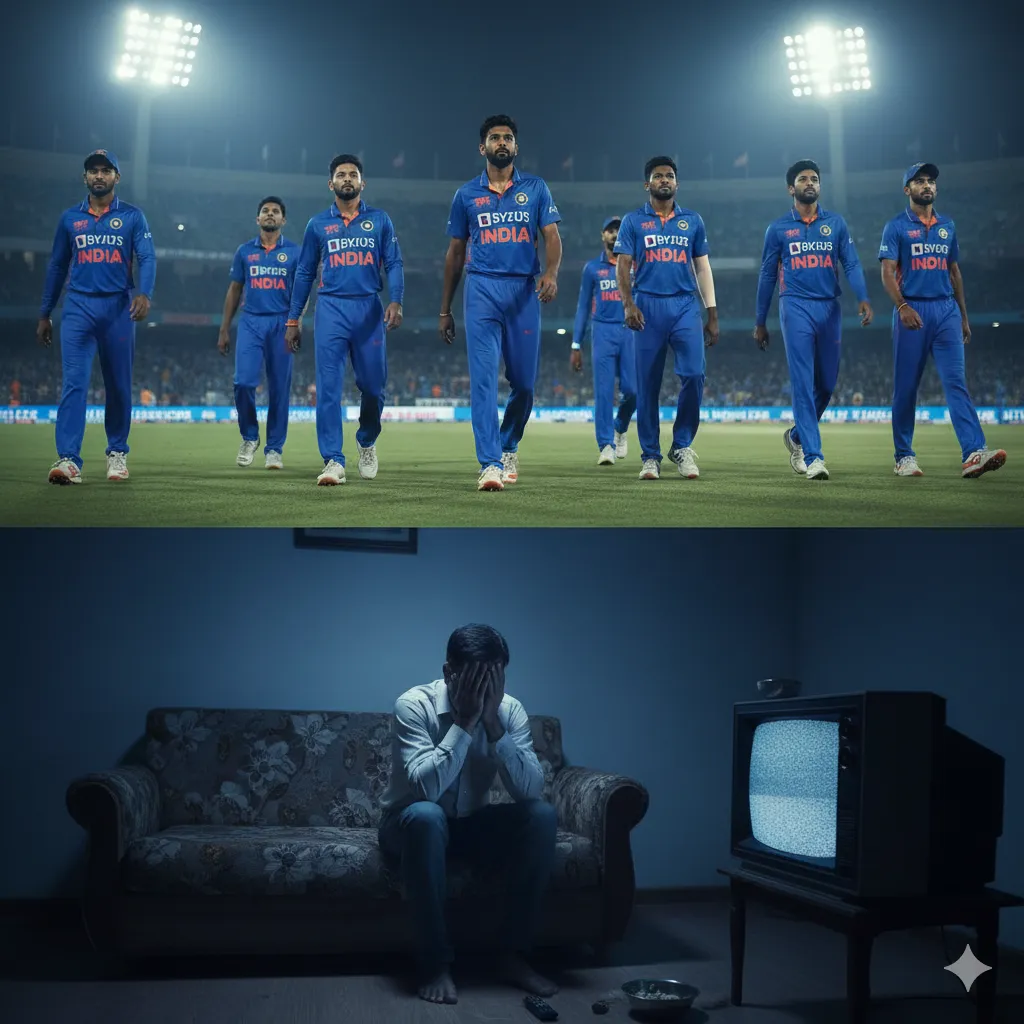
In 2023, after India lost the Cricket World Cup final, at least two fans died by suicide. Take a moment to sit with that. A game of cricket — played by eleven men who went home afterward, had dinner, slept in their beds, and woke up the next morning to continue their lives — ended, and two people in different states decided their own lives were no longer worth living.
The players who actually lost the match? They were fine. Disappointed, sure. Frustrated, certainly. But alive. Functional. Moving on.
The fans who watched it on television? Dead.
This is not about cricket. This is about what happens when "I am Indian" or "I am a cricket fan" gets loaded with so much identity weight that a sporting result can crack your foundation. The team was their functional identity mistaken for a foundational one. When the team fell, they fell. When the team lost, they lost — everything.
Krishna's teaching in 2.13 is not abstract philosophy for monks in caves. It is a survival manual. If those two fans had understood — really understood, not just intellectually agreed with — that they are eternal souls whose worth does not depend on eleven men chasing a leather ball, they would be alive today.
The Layoff That Felt Like Death
Open any tech forum after a round of layoffs and you will find the same language repeated like a liturgy of grief. "I don't know who I am anymore." "I can't face my family." "I feel worthless." "My whole identity was tied to that company."
Read that last line again. They are telling you exactly what went wrong. My whole identity was tied to that company.
One article described laid-off Big Tech workers as being "haunted" by a single thought — that without their job, they have no purpose. Some could not bring themselves to tell their spouses for weeks. Others withdrew from friends and family entirely. The shame was so overwhelming that basic human connection became impossible.
But ask yourself — are you worth nothing without a job? Really? Are you not a father, a friend, a soul with seventy years of accumulated experience and wisdom and love? Does your value as a conscious being really depend on whether a corporation has your name on a payroll?
Of course not. Everyone knows this intellectually. But when your functional identity as "Senior Engineer at Meta" has been doing the work of your foundational identity for fifteen years, knowing it intellectually is not enough. The foundation cracks and there is nothing underneath.
This is exactly why Krishna did not start the Gita with career advice. He started with dehino 'smin. He started with: before you are a warrior, before you are a prince, before you are a son, before you are anything at all in this world — you are a soul. Everything else is a costume you are wearing for this particular act of this particular play. Important costumes, yes. But costumes.
The Body Beautiful Trap

Now shrink the lens even further. Forget countries and careers. Think about a pimple.
A pimple. A tiny inflammation of a skin follicle. And it can ruin someone's week. Cancel their plans. Make them avoid cameras, dodge social gatherings, spiral into self-loathing.
Why? Because "I am this body" has been accepted so completely, so unconsciously, that any blemish on the body feels like a blemish on the self. If your face is you, then a pimple is not a skin condition — it is an identity crisis in miniature.
And God forbid your karma has written a life of acne, or weight struggles, or early graying, or any of the thousand things that bodies do simply because bodies are temporary machines running on borrowed time. If your foundational identity is "I am a good-looking person," then every year that passes is an enemy. Aging is not a natural process — it is a personal attack. Every wrinkle is a loss. Every gray hair is a defeat.
Krishna addressed this directly. Kaumāraṁ yauvanaṁ jarā — from childhood to youth to old age. The body is always changing. Always. If you hitch your identity to something that is always changing, you will always be in crisis. The soul, the dehi, does not age, does not wrinkle, does not get pimples. But you have to actually know this — not as a slogan, but as a lived reality.
Careers Before Cradles
A recent report from Delhi highlighted a growing trend — women in their thirties choosing to delay children, sometimes indefinitely, because pregnancy and motherhood might interrupt their career trajectory or change their physical appearance.
Now, nobody is suggesting that women should not have careers. Nobody is saying professional ambition is wrong. But when the career becomes so central to identity that the natural human experience of parenthood — something that every generation before us managed to integrate into life — starts to feel like a threat, something has gone sideways.
What is being protected here? Not the career itself — careers can be paused and resumed, as millions of women have demonstrated. What is being protected is the identity built around the career. The sense of self that says: I am my professional accomplishments, my title, my income bracket, my LinkedIn profile. And anything that disrupts that — even the creation of new life — is experienced as a loss.
This is functional identity in the driver's seat, and foundational identity locked in the trunk.
The Question List
Let's make this uncomfortable for a moment. Ask yourself:
What happens if you cannot get married — or remarried? What happens if you cannot have a child? What happens if you never earn a big salary? What happens if you are always dealing with some health issue? What happens if you are an introvert in a world that rewards extroverts? What happens if you can never build your own home? What happens if your spouse is not conventionally attractive? What happens if your child has a developmental disability? What happens if your child is not academically gifted? What happens if you are not the charismatic one in the room? What happens if you cannot dance at a wedding?
If any of these scenarios fills you with existential dread — not mild disappointment, but genuine dread — then you have found the functional identity that has been doing unauthorized overtime as your foundational one.
And here is the hard truth: many of these things will happen to you. Maybe not all of them. But life will take some of your functional identities and crush them. It is not a question of if. It is a question of when. Bodies age. Jobs end. Children grow up and leave. Countries lose matches. Marriages go through seasons. Health deteriorates.
The only identity that cannot be taken from you is the one Krishna pointed to first: you are an eternal spirit soul, part and parcel of the Supreme Lord.
So What Do We Actually Do?
Philosophy without practice is just poetry. So let's talk about what this looks like in daily life.
First, understand that nobody is asking you to abandon your functional identities. Krishna did not tell Arjuna to stop being a warrior. He told him to be a warrior properly — but from the platform of spiritual identity. You can be an excellent mother, a dedicated employee, a proud Indian, a loving spouse — all of it. The problem was never the roles. The problem was the ranking.
Your foundational identity should be foundational. That means it sits underneath everything else. It is the floor, not the ceiling. When a functional identity gets shaken — and it will — you do not fall into the void because there is something solid beneath you.
Second, connection is not optional. You cannot maintain spiritual identity in isolation. Krishna makes this clear throughout the Gita, and the entire tradition reinforces it — you need the association of devotees. Not as a social club. Not as a networking opportunity. As a lifeline. Devotees remind you of who you actually are when the world is screaming at you about who you should be. They are mirrors that reflect your foundational identity back to you when you have forgotten it.
Find devotees. Stay close to them. Your life and your death — your ability to navigate both with grace — depends on that connection.
Third, practice. The reason Krishna gave Arjuna not just philosophy but a path — karma yoga, bhakti yoga, jnana yoga — is because identity is not changed by agreement alone. You can nod along with every word in this article and still fall apart at the next layoff. Knowing is not enough. You have to practice being the soul. Chanting, hearing, serving, remembering — these are not rituals. They are identity exercises. They are how you train yourself to live from the foundation instead of the function.
Fourth, watch yourself honestly. When something small makes you disproportionately upset — a comment, a comparison, a setback — pause and ask: which identity just got threatened? Was it foundational or functional? Nine times out of ten, you will find that a functional identity snuck into the foundation when you were not looking. Name it. See it. Gently put it back where it belongs.
The Freedom in Getting This Right

That elderly couple I mentioned — living with their son, pursuing devotional service, studying scripture at an age when most people are nursing grievances — they are not performing some superhuman feat of renunciation. They are simply living from the right identity.
And the freedom that comes from that is extraordinary. When your foundational identity is secure, you can let your son's wife be first in his life without it destroying you. You can lose a job without losing yourself. You can age without terror. You can watch your country lose a match and feel disappointed without feeling deleted.
You can have a pimple and still go to the party.
This is what Krishna was offering Arjuna in that very first teaching. Not escape from life, but the ability to live it fully, fearlessly, with an unshakeable sense of who you really are beneath every costume change.
Dhīras tatra na muhyati — the sober person is not bewildered by any of this.
Not because they do not care. But because they know who they are.
And that — knowing who you are, really, at the foundation — is not the end of the journey. It is the beginning. It is the first step toward understanding why you are here, what you are meant to give, and who you are meant to love.
We are Krishna's children. We do not need to be perfect. We just need to connect with Him. And His devotees will help us make that connection — there is no other way. So before anything else, before fixing any functional identity, before optimizing any role — connect with His devotees. Everything else follows from there.